
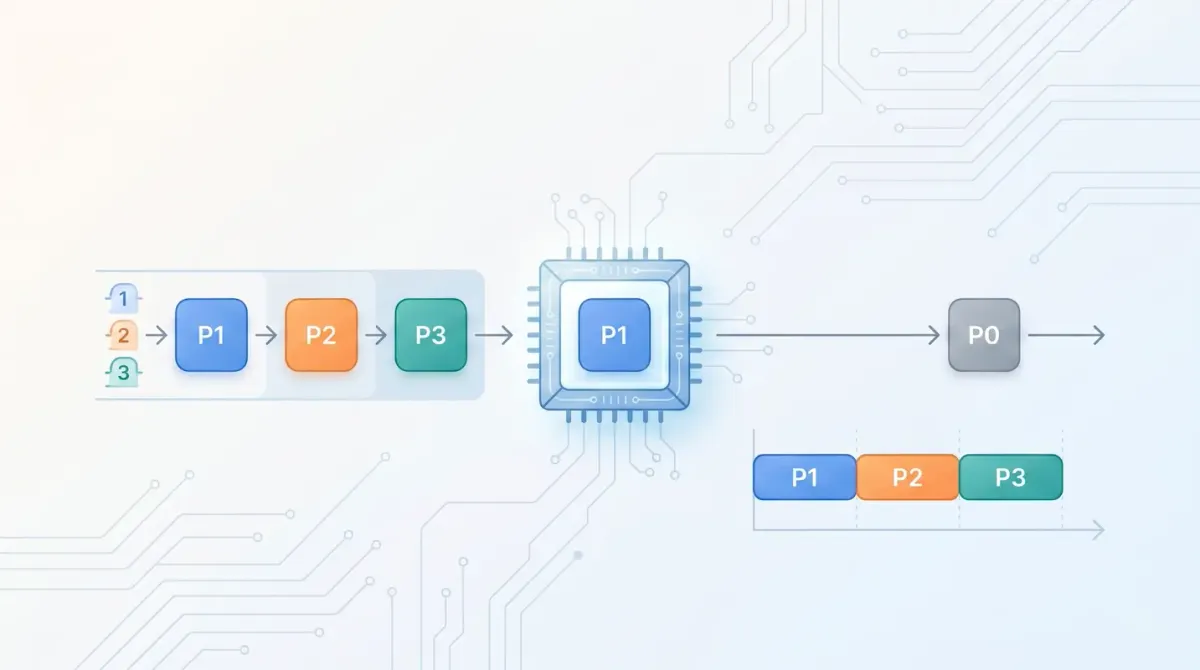
Modern computers are capable of doing many tasks at the same time. You can listen to music, browse the internet, download files, and type a document simultaneously without your computer freezing. To users, this multitasking ability feels completely natural. However, behind the scenes, the operating system must constantly decide which program gets access to the processor first.
This decision-making process is known as CPU scheduling.
Today, operating systems use highly advanced scheduling systems that can intelligently manage thousands of tasks every second. However, long before modern AI-driven schedulers existed, computer scientists relied on a much simpler method called the First Come First Serve (FCFS) algorithm.
FCFS is one of the oldest and most important scheduling algorithms in computer science history. Even though modern systems rarely use it as their primary scheduler anymore, it still forms the foundation for understanding how CPU scheduling works. For students learning operating systems, FCFS is usually the very first scheduling algorithm introduced because it clearly demonstrates the core principles of process management.
What Is the First Come First Serve Algorithm?
The First Come First Serve algorithm is the simplest type of CPU scheduling technique used in operating systems.
As the name suggests, the process that arrives first gets executed first. The operating system processes tasks strictly in the order they enter the queue, without considering how large, important, or complex the tasks are.
A simple real-world example is standing in a supermarket checkout line. The customer who arrives first is served first, regardless of how many items they are buying. Someone with only one item still has to wait behind a customer with a full shopping cart.
FCFS applies the exact same idea to computer processes.
When a process requests CPU access:
- it joins the ready queue
- the process at the front gets CPU access first
- all other processes must wait for their turn
This straightforward behavior makes FCFS incredibly easy to understand and implement.
The Historical Background of FCFS
To understand why FCFS became important, we need to look back at the early days of computing during the 1960s. At that time, personal computers did not exist. Instead, organizations used massive mainframe computers that filled entire rooms. These systems were extremely expensive and mainly used by universities, research centers, and governments.
One famous example was the IBM 7094 mainframe system introduced in 1962.
Users did not interact directly with these computers through keyboards and screens like we do today. Instead, programmers wrote programs on punched cards and submitted them to computer operators. The operator placed these jobs into a queue, and the computer processed them one by one.
This system was known as batch processing.
Since users were not expecting immediate responses, the simplest and most logical scheduling method was to process jobs in the exact order they arrived. There was no need for multitasking or fast interaction.
This naturally led to the development of the First Come First Serve algorithm.
How FCFS Works Internally
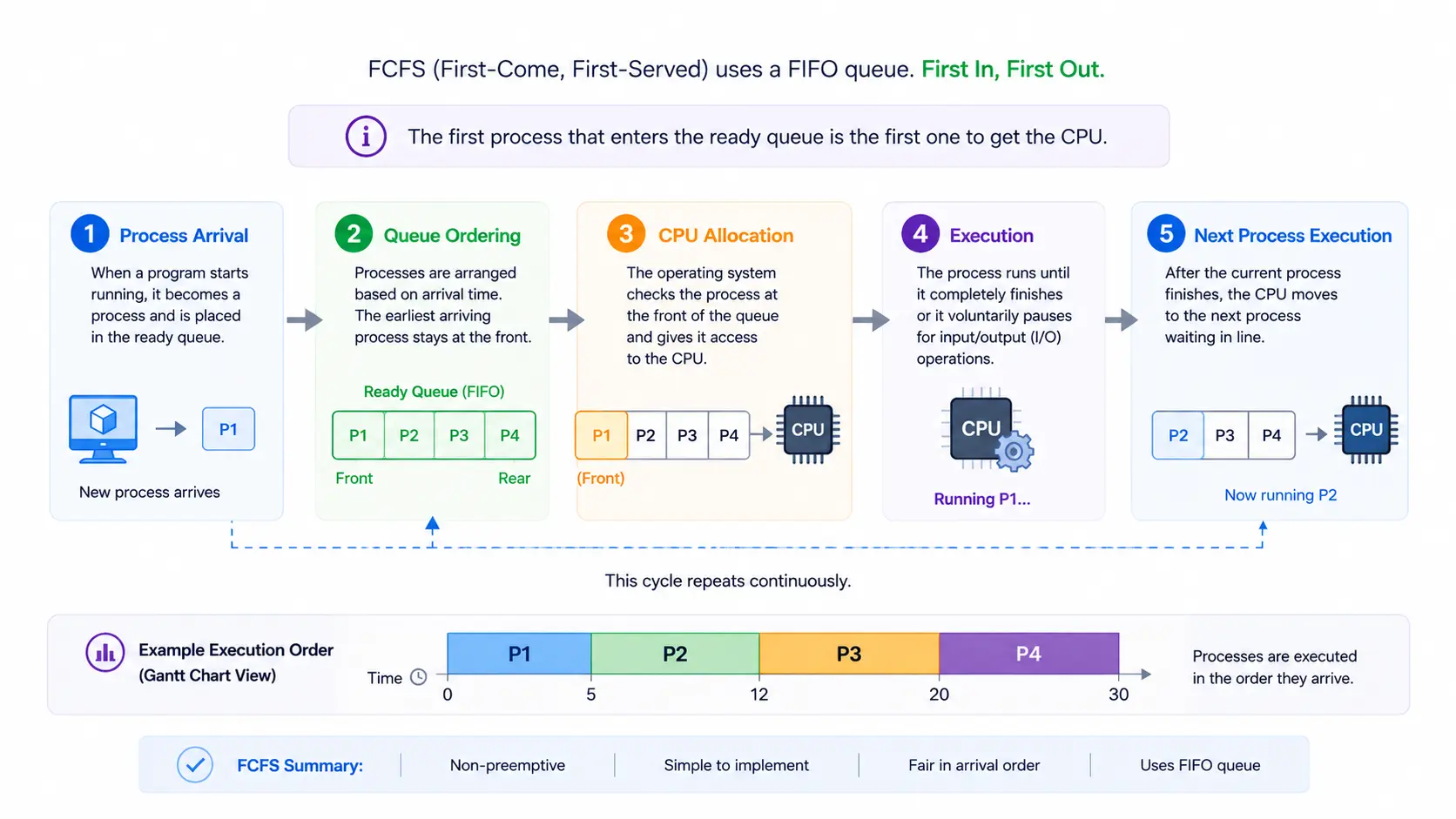
FCFS works using a data structure called a FIFO queue, which stands for:
- First In
- First Out
This means the first process entering the queue is the first process removed and executed. The scheduling process follows several basic steps.
Step 1: Process Arrival
Whenever a program starts running, it becomes a process. The operating system places this process into the ready queue.
Step 2: Queue Ordering
Processes are arranged based on arrival time. The earliest arriving process stays at the front.
Step 3: CPU Allocation
The operating system checks the process at the front of the queue and gives it access to the CPU.
Step 4: Execution
The process runs until:
- it completely finishes
- or it voluntarily pauses for input/output operations
Step 5: Next Process Execution
After the current process finishes, the CPU moves to the next process waiting in line.
This cycle repeats continuously.
FCFS Is a Non-Preemptive Scheduling Algorithm
One of the most important characteristics of FCFS is that it is a non-preemptive scheduling algorithm.
Non-preemptive means the operating system cannot interrupt a running process and forcibly remove it from the CPU.
Once a process starts running:
- it keeps full control of the processor
- no other process can interrupt it
- all remaining processes must wait
This behavior creates simplicity but also introduces major performance problems.
Modern operating systems usually use preemptive scheduling because it allows the system to switch rapidly between tasks and maintain responsiveness.
Important Scheduling Terms in FCFS
To properly understand FCFS, it is important to learn several key scheduling terms used in operating systems.
Arrival Time
Arrival Time refers to the exact moment a process enters the ready queue.
Burst Time
Burst Time is the amount of CPU time a process needs to complete execution.
A small process may require only a few milliseconds, while heavy tasks may require much longer CPU bursts.
Completion Time
Completion Time is the exact moment a process fully finishes execution.
Turnaround Time
Turnaround Time measures the total amount of time a process spends in the system.
Formula:
Turnaround Time = Completion Time - Arrival Time
Waiting Time
Waiting Time represents how long a process waits inside the queue before execution starts.
Formula:
Waiting Time = Turnaround Time - Burst Time
These metrics help operating system designers evaluate scheduler performance and efficiency.
Practical Example of FCFS Scheduling
Let us imagine three processes entering the CPU queue at the same time.
| Process | Burst Time |
|---|---|
| P1 | 24 ms |
| P2 | 3 ms |
| P3 | 3 ms |
Since FCFS follows arrival order:
- P1 executes first
- P2 waits
- P3 waits even longer
Execution Process
- Process P1: P1 immediately receives CPU access and runs for 24 milliseconds.
- Process P2: P2 waits until P1 finishes. It starts at 24 milliseconds and finishes at 27 milliseconds.
- Process P3: P3 waits for both previous processes and finishes at 30 milliseconds.
Waiting Time Calculation
| Process | Waiting Time |
|---|---|
| P1 | 0 ms |
| P2 | 24 ms |
| P3 | 27 ms |
Average Waiting Time:
(0 + 24 + 27) / 3 = 17 ms
This example reveals one of the biggest weaknesses of FCFS scheduling.
The Convoy Effect: The Biggest Problem in FCFS
The most serious disadvantage of FCFS is called the Convoy Effect. This occurs when one large process blocks many smaller processes behind it.
Imagine standing in a supermarket line behind a customer with hundreds of items while you only want to buy one bottle of water. Even though your purchase would take seconds, you are forced to wait.
The same thing happens in FCFS scheduling.
A heavy CPU-intensive task can:
- block smaller programs
- increase waiting times
- slow the entire system
- reduce responsiveness
This creates severe inefficiencies.
While one massive process uses the CPU, smaller tasks remain stuck waiting. Meanwhile, other hardware resources like disk drives and network devices may sit idle.
The Convoy Effect became one of the main reasons engineers abandoned pure FCFS scheduling in modern operating systems.
Advantages of FCFS
Despite its flaws, FCFS still offers several advantages:
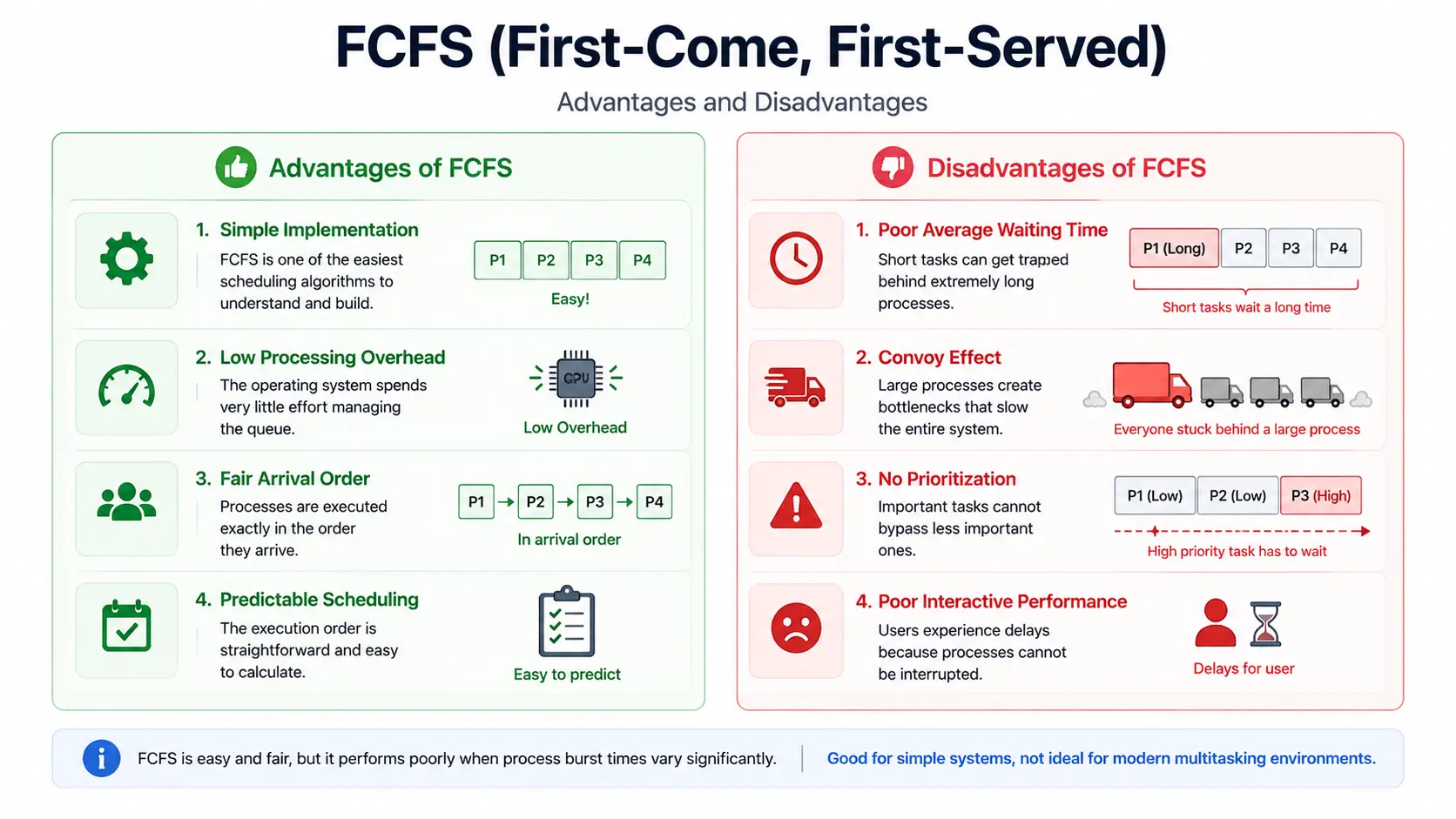
- Simple Implementation: FCFS is one of the easiest scheduling algorithms to understand and build.
- Low Processing Overhead: The operating system spends very little effort managing the queue.
- Fair Arrival Order: Processes are executed exactly in the order they arrive.
- Predictable Scheduling: The execution order is straightforward and easy to calculate.
Because of these advantages, FCFS remains useful in certain specialized systems.
Disadvantages of FCFS
FCFS also has several serious disadvantages.
- Poor Average Waiting Time: Short tasks can get trapped behind extremely long processes.
- Convoy Effect: Large processes create bottlenecks that slow the entire system.
- No Prioritization: Important tasks cannot bypass less important ones.
- Poor Interactive Performance: Users experience delays because processes cannot be interrupted.
These weaknesses made FCFS unsuitable for modern multitasking systems.
Why Modern Operating Systems Moved Beyond FCFS
As computers evolved into interactive systems, users demanded:
- instant responses
- smooth multitasking
- responsive interfaces
FCFS could not meet these expectations because one large task could freeze the system for long periods.
This led to the invention of preemptive scheduling algorithms such as:
- Round Robin
- Shortest Job First
- Priority Scheduling
One major milestone was the development of the Compatible Time-Sharing System (CTSS) at MIT in the early 1960s. CTSS introduced time-sharing concepts that allowed multiple users to interact with the computer simultaneously.
These newer scheduling techniques allowed operating systems to:
- interrupt processes
- distribute CPU time fairly
- improve responsiveness
- eliminate the Convoy Effect
Where FCFS Is Still Used Today
Although modern CPUs no longer rely heavily on FCFS, the algorithm is still useful in several specialized systems.
- Printer Queues: Printers usually process documents in the order they are received.
- Backup Systems: Background backup tasks often follow sequential execution.
- Storage Operations: Some disk scheduling systems still use FCFS behavior for predictable access.
- Embedded Systems: Small low-power devices sometimes use FCFS because it is lightweight and easy to implement.
Its simplicity keeps it relevant even today.
FCFS vs Modern Scheduling Algorithms
Compared to modern scheduling systems, FCFS is extremely basic.
Modern schedulers focus on:
- fairness
- responsiveness
- multitasking efficiency
- reducing waiting times
However, FCFS remains historically important because it introduced the foundational ideas behind process scheduling.
Without FCFS, the development of modern CPU scheduling algorithms would have been much more difficult.
Conclusion
The First Come First Serve algorithm is one of the earliest and most fundamental CPU scheduling techniques in computer science. By processing tasks in the exact order they arrive, FCFS introduced the basic concepts of process scheduling and queue management.
Although its non-preemptive nature and Convoy Effect make it inefficient for modern interactive systems, it still plays an important role in education and specialized computing environments.
Understanding FCFS helps students and developers build a strong foundation in operating system design and CPU scheduling concepts. Even though newer algorithms dominate today's systems, the legacy of FCFS remains deeply connected to the history and evolution of modern computing.
Sources - geeksforgeeks.org, theknowledgeacademy.com