
In today’s digital world, real-time communication has become an essential part of our daily lives. From online classes and remote work meetings to video calls with friends, technologies that enable instant communication are more important than ever. One of the most powerful technologies behind these applications is WebRTC.
WebRTC has made it possible to build audio, video, and data sharing applications directly in web browsers without requiring additional plugins or software. Whether you are a student, developer, or tech enthusiast, understanding how WebRTC works can help you build modern, real time applications.
In this article, we will explore what WebRTC is, why it is important, how it works internally, and how you can use it to build a simple video calling application.
What is WebRTC?
WebRTC (Web Real Time Communication) is an open source technology that enables real time communication between browsers and devices. It allows users to share audio, video, and data directly without needing intermediate plugins.
In simple terms, WebRTC allows two users to communicate directly with each other through their browsers. This is known as peer to peer (P2P) communication.
For example, applications like Google Meet and Zoom use similar real time communication technologies to enable video calls.
Why is WebRTC Important?
WebRTC is important because it simplifies the process of building real time communication systems. Traditionally, developers needed complex server infrastructures to handle audio and video streaming. WebRTC reduces this complexity by enabling direct communication between users.
One key advantage is reduced latency. Since data is transmitted directly between peers, communication becomes faster and more efficient. This is crucial for applications such as video conferencing, online gaming, and live streaming.
Another important aspect is accessibility. WebRTC works directly in modern web browsers, making it easy for users to join calls without installing additional software.
Key Concepts and Components
To understand WebRTC properly, it is important to learn its core components.
Peer to Peer Communication
WebRTC primarily uses peer to peer communication, meaning that data flows directly between users instead of passing through a central server. This reduces delay and improves performance.
Signaling
Although WebRTC enables direct communication, it still requires a signaling mechanism to exchange connection information between peers. This is usually implemented using technologies like Socket.IO or WebSockets.
Signaling is responsible for exchanging messages such as connection offers, answers, and network information.
SDP (Session Description Protocol)
SDP is used to describe the media capabilities of each peer. It contains information about audio, video formats, and network settings.
When a connection is established, one peer sends an “offer” and the other responds with an “answer.” This exchange helps both peers understand how to communicate.
ICE (Interactive Connectivity Establishment)
ICE is responsible for finding the best possible path between two peers. It collects multiple connection options and tests them to determine the most efficient route.
STUN Server
A STUN server helps a device discover its public IP address. Since most devices are behind private networks, this step is necessary to establish a connection over the internet.
TURN Server
If a direct peer to peer connection cannot be established due to network restrictions, a TURN server is used as a relay. In this case, data passes through the TURN server instead of directly between peers.
How WebRTC Works
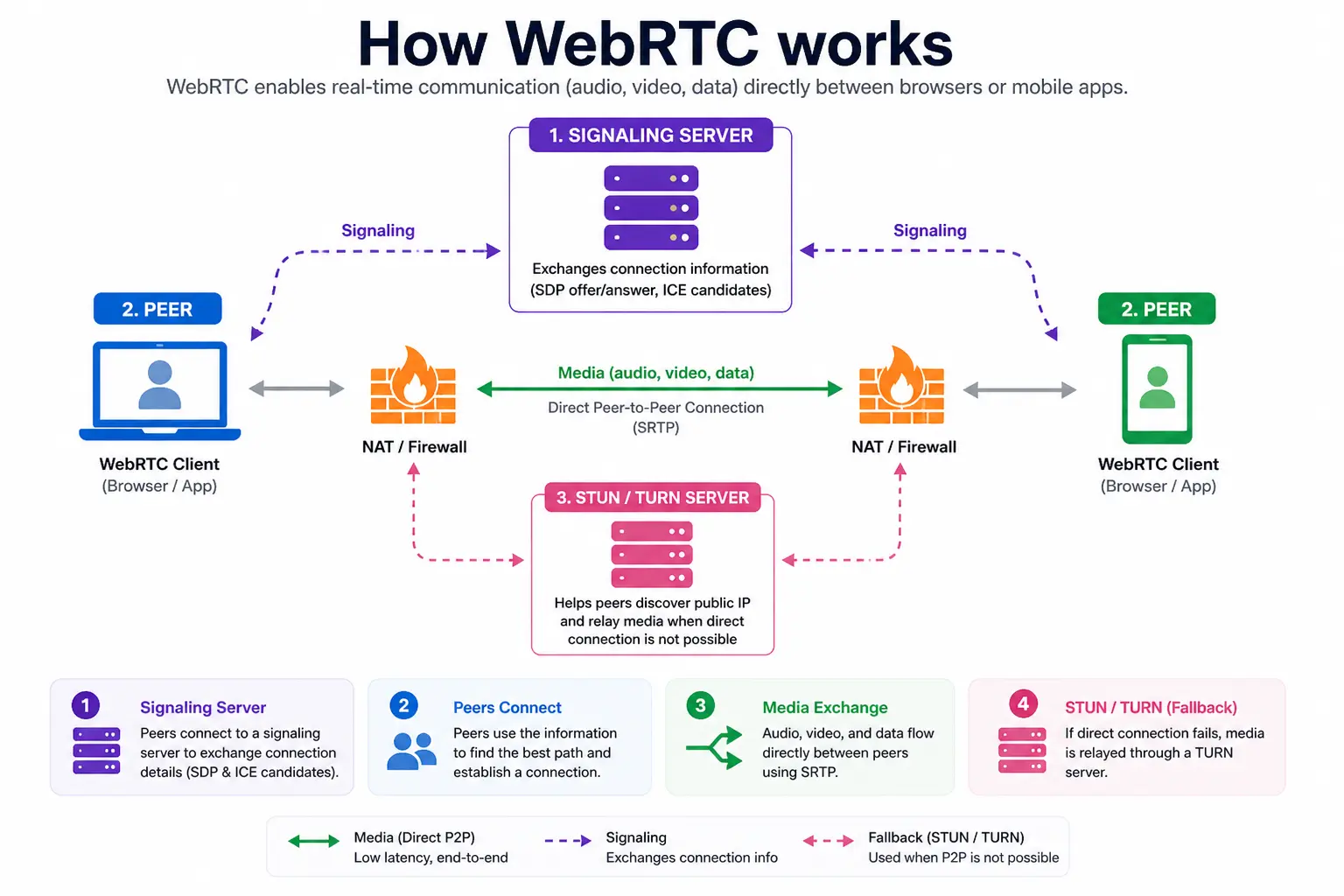
The working process of WebRTC can be understood in several steps.
First, both users grant permission to access their camera and microphone using browser APIs. Then, one user creates an offer containing session information (SDP) and sends it to the other user through a signaling server.
The second user receives the offer and responds with an answer. This exchange ensures that both peers agree on how to communicate.
Next, ICE candidates are gathered and exchanged. These candidates represent possible network paths for the connection. Using this information, WebRTC selects the best route for communication.
Once the connection is established, audio and video streams are transmitted directly between the users in real time.
Real World Examples of WebRTC
WebRTC is widely used in modern applications. Video conferencing platforms like Google Meet and Zoom rely on similar technologies to enable real time communication.
Customer support systems also use WebRTC to provide live chat and video assistance. Online education platforms use it for virtual classrooms, enabling students and teachers to interact in real time.
Another example is peer to peer file sharing and real time collaboration tools, where users can exchange data directly without relying on central servers.
Advantages of WebRTC
WebRTC offers several advantages that make it a powerful technology.
One of the main benefits is low latency. Direct communication between peers reduces delays, making interactions more responsive.
Another advantage is cost efficiency. Since media streams do not pass through a central server, infrastructure costs are reduced.
WebRTC is also highly accessible, as it works directly in modern browsers without requiring additional installations.
Additionally, it supports multiple types of data, including audio, video, and arbitrary data, making it versatile for different applications.
Disadvantages and Challenges
Despite its advantages, WebRTC has some challenges.
One major issue is network complexity. Establishing connections between peers can be difficult due to firewalls and NAT configurations.
Another challenge is the need for TURN servers in certain cases. These servers increase cost and can introduce additional latency.
Security is also a concern. Although WebRTC includes encryption by default, developers must still ensure proper implementation to protect user data.
Future Trends in WebRTC
WebRTC continues to evolve as real time communication becomes more important. One major trend is its integration with artificial intelligence, enabling features such as real time transcription, background noise removal, and facial recognition.
Another trend is the use of WebRTC in the Internet of Things (IoT), where devices communicate in real time.
WebRTC is also being used in augmented reality (AR) and virtual reality (VR) applications to enable immersive communication experiences.
As web technologies advance, WebRTC is expected to become even more powerful and widely adopted.
Tips and Best Practices for Beginners
For beginners, learning WebRTC can seem complex, but a structured approach makes it manageable.
Start by understanding the basic concepts such as peer to peer communication, signaling, and SDP exchange. Then, build a simple project like a one to one video call application.
Use tools like Socket.IO to implement signaling. Experiment with different configurations and observe how connections are established.
It is also important to learn about STUN and TURN servers, as they play a crucial role in real world applications.
Finally, practice regularly and explore advanced features such as screen sharing and data channels.
Conclusion
WebRTC is a powerful technology that enables real time communication directly between browsers and devices. By eliminating the need for complex server infrastructure, it simplifies the development of audio, video, and data sharing applications.
For students and developers, understanding WebRTC provides a strong foundation for building modern communication systems. Although it may seem complex at first, breaking it down into core concepts makes it easier to learn and apply.
As real time applications continue to grow, WebRTC will remain a key technology in the future of web development.
Sources - World Wide Web Consortium, Mozilla, Google Developers, IETF