How Fast Charging Protocols Work: The Complete Technical Guide

 English
 Russian
 Español
 Français
 Deutsch
 हिन्दी
 සිංහල
සිංහල 中文
中文 日本語
日本語
Ten years ago, charging a smartphone was a slow process. You plugged it in at night, and by morning, it was full. Today, we have phones that can charge from 0% to 100% in under 15 minutes.
This technology feels like magic, but it is actually a complex mix of physics, chemistry, and digital communication.
However, the market is confusing. You see terms like USB PD 3.1, PPS, Quick Charge 5, SuperVOOC, and HyperCharge. If you buy the wrong charger, your expensive flagship phone might charge at the speed of a device from 2015.
In this comprehensive guide, we will break down exactly how fast charging works, the science behind the "Handshake," and how to choose the perfect charger for your device.
The Physics of Speed (Volts vs. Amps)
To understand fast charging, you don't need a degree in engineering. You only need to know one simple formula:
Volts (V) × Amps (A) = Watts (W)
Think of electricity flowing into your battery like water flowing through a garden hose to fill a bucket.
- Volts (V) is the Water Pressure.
- Amps (A) is the Width of the Hose.
- Watts (W) is the Total Amount of Water entering the bucket per second.
To fill the bucket (charge the battery) faster, you have two choices:
- Increase the Pressure (High Voltage): Force the water through faster. This is how USB Power Delivery (PD) and Qualcomm Quick Charge traditionally worked.
- Widen the Hose (High Amperage): Use a wider pipe to let more water flow easily. This is how proprietary Chinese tech like OPPO SuperVOOC works.
The Enemy: Heat
Why can't we just use infinite pressure and a giant hose? The answer is Resistance.
When you push electricity into a battery, some of it turns into heat. If the battery gets too hot (usually over 45°C / 113°F), it degrades chemically or can even explode. Therefore, every fast charging protocol is actually a Temperature Management System.
The "Handshake" (How Chargers Talk)
The secret to modern fast charging is that the charger is no longer a "dumb" brick. It is a smart computer.
When you plug your phone into a USB-C charger, a digital conversation happens in the first few milliseconds. This is called the "Handshake."
The Step-by-Step Negotiation:
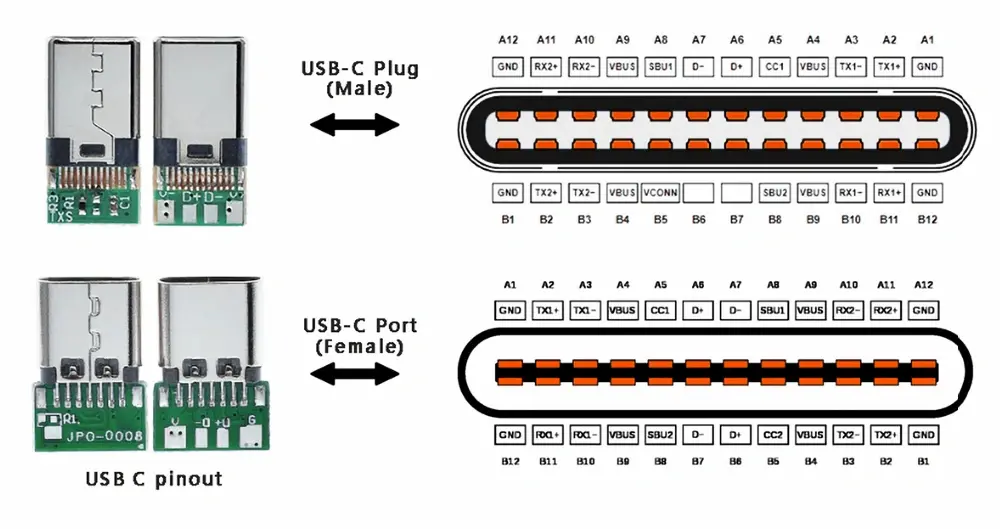
- Connection: You plug in the cable. The charger sends a tiny signal (0.005 Volts) via the CC Pins (Configuration Channel) inside the USB-C head to detect if a device is attached.
- Identification: The phone says, "Hello, I am a Samsung Galaxy S25, and I support USB PD 3.0 and PPS."
- Offer: The charger replies, "I can offer the following power profiles: 5V/3A, 9V/3A, or 15V/3A."
- Selection: The phone calculates its current battery level and temperature. It replies, "Give me 9V at 3A (27 Watts)."
- Power Delivery: The charger switches on the high power.
The Role of the "E-Marker" Chip
Have you ever wondered why some USB-C cables are $5 and others are $20?
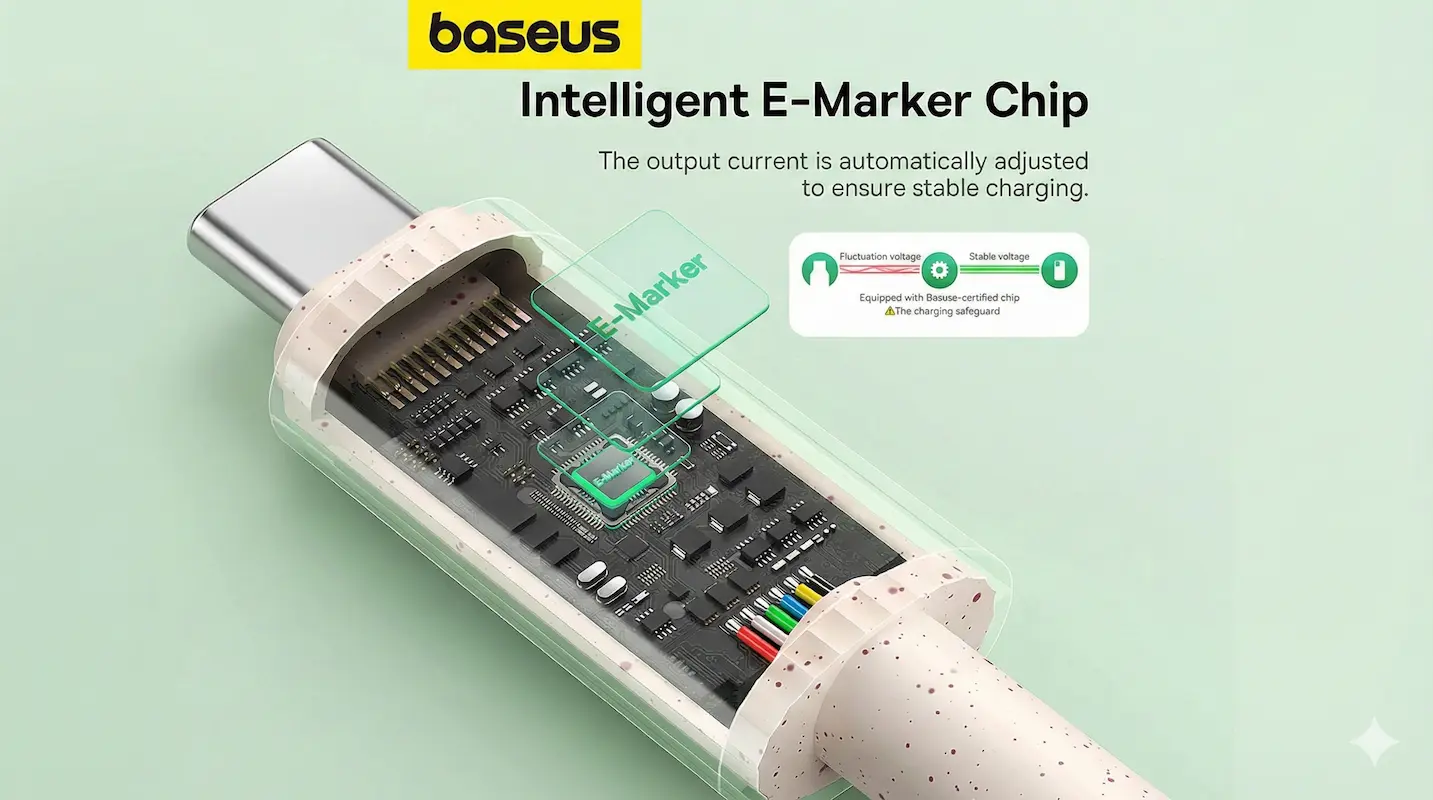
For charging speeds above 60 Watts (or 3 Amps), the cable must have a tiny microchip inside the plug called an E-Marker (Electronic Marker).
- During the handshake, the charger asks the cable: "Can you handle 5 Amps?"
- If the cable has no chip, the charger assumes it is cheap and weak, and limits the speed to safe slow charging (usually 60W max) to prevent the cable from melting.
The Universal Standard (USB Power Delivery)
USB Power Delivery (USB PD) is the open standard created by the USB-IF organization. It is used by Apple (iPhone/MacBook), Google (Pixel), Samsung, and almost all laptops.
Version 1: USB PD 3.0 (Standard Power Range - SPR)
This is the most common version. It supports charging up to 100 Watts.
It uses fixed voltage steps: 5V, 9V, 15V, and 20V.
Version 2: USB PD 3.1 (Extended Power Range - EPR)
Released recently, this standard pushes the limit to 240 Watts.
It adds new voltages: 28V, 36V, and 48V. This is designed for high-performance gaming laptops that used to require bulky proprietary power bricks.
The Secret Weapon: PPS (Programmable Power Supply)
This is the most important feature for Samsung and Pixel users.
In standard PD, the voltage is fixed. If your phone needs 8 Volts but the charger only offers 9 Volts, the phone has to take 9V and convert the excess energy into heat inside the phone. This is bad.
- PPS Mode: The phone can tell the charger, "Give me exactly 8.4 Volts."
- The charger adjusts its output in tiny 0.02V steps.
- Result: Almost zero energy is wasted, the phone stays cool, and it charges faster.
Proprietary Protocols (The "Speed Kings")
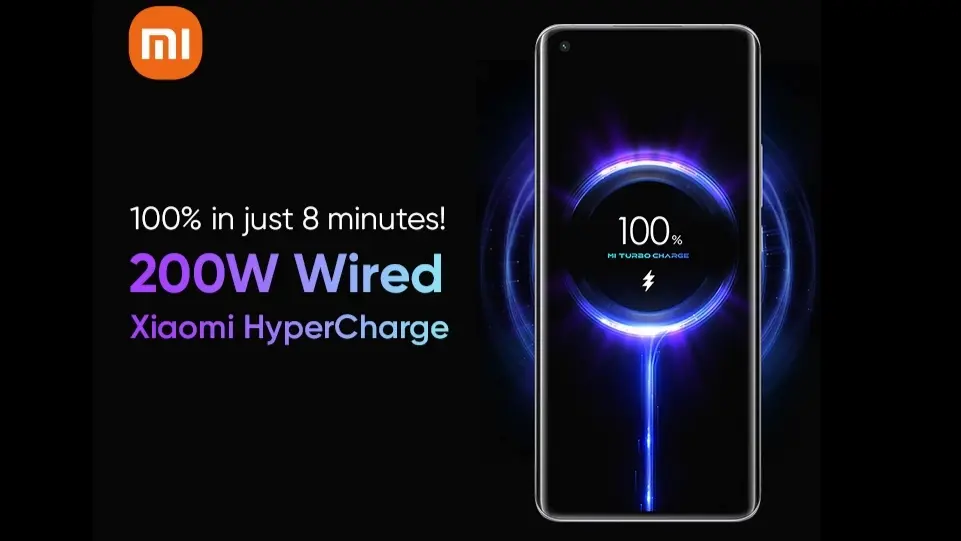
If USB PD is so good, why do brands like Xiaomi, OPPO, OnePlus, and Realme use their own standards (HyperCharge, SuperVOOC)?
Because USB PD has a flaw: it usually converts high voltage inside the phone, which creates heat.
Chinese manufacturers use a "Direct Charging" method (High Amperage).
- Current: They use massive current (6 Amps, 10 Amps, or even 12 Amps).
- The Brick: They move the voltage conversion circuitry from the phone to the charging brick. The brick gets hot, but the phone stays cool.
- Dual-Cell Batteries: Instead of one big battery, these phones have two smaller batteries inside. If you charge at 120W, the phone splits it, sending 60W to Battery A and 60W to Battery B simultaneously.
The Downside: You must use the proprietary cable. These cables are thicker (to handle the "wider hose" of electricity) and have special extra pins. If you use a regular USB-C cable, the speed drops instantly.
Qualcomm Quick Charge (QC)
Quick Charge (QC) used to be the king of Android charging.
- Legacy (QC 2.0 / 3.0): Used high voltage but was inefficient compared to modern standards.
- Modern (QC 5.0): Qualcomm realized they couldn't beat USB PD, so they joined them. QC 5.0 is basically a rebranded version of USB PD PPS. It supports speeds over 100W and is backward compatible with older devices.
What is GaN? (The Hardware Revolution)
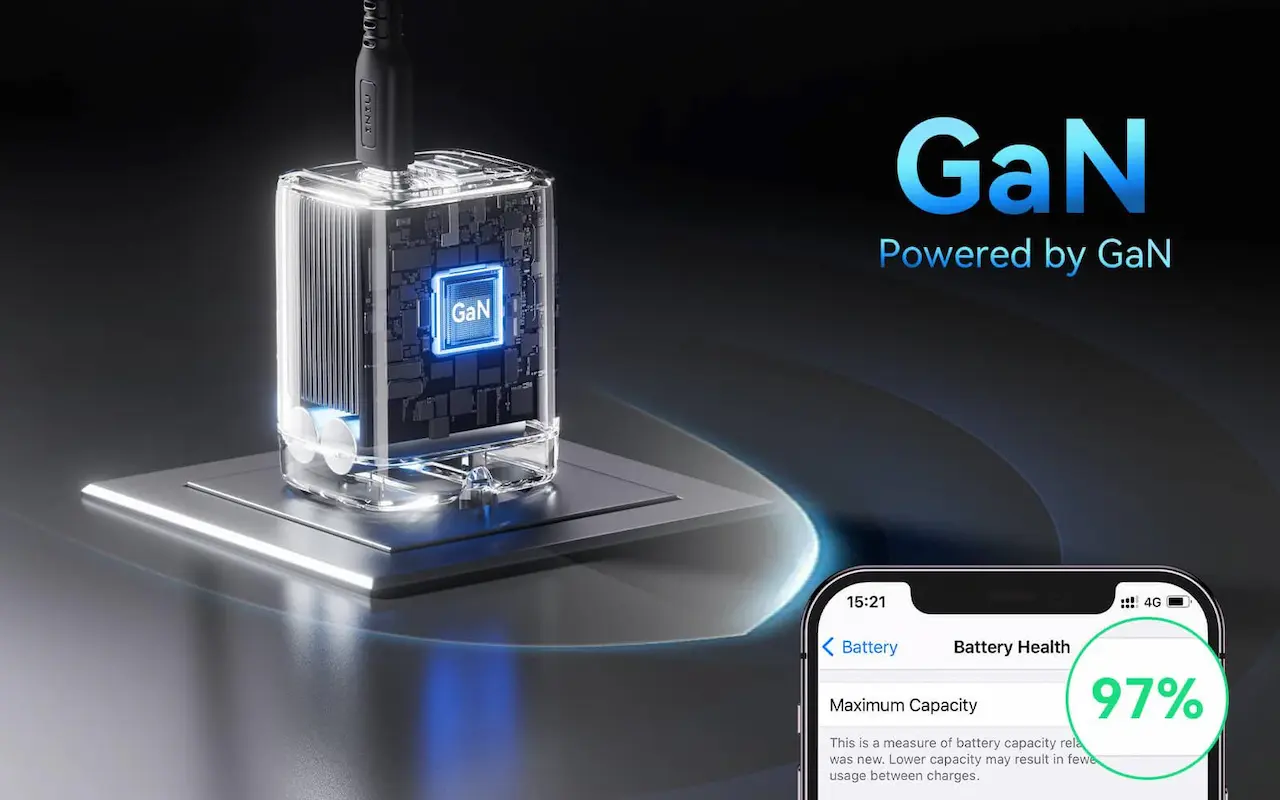
You will see the term "GaN" on almost every premium charger box in 2025. This describes the material inside the charger, not the software.
- The Old Way (Silicon): Traditional chargers used silicon transistors. They were cheap but not very efficient at handling heat, so powerful chargers had to be physically large (like old laptop bricks).
- The New Way (Gallium Nitride): GaN is a crystal material that conducts electricity much better than silicon. It produces far less heat.
- The Benefit: Because it runs cooler, engineers can pack the components much closer together. This is why a modern 65W GaN charger is the size of a cookie, while an old 65W laptop charger was the size of a brick.
Why Does Charging Slow Down at 80%?
No matter how fast your charger is, it will always slow down at the end. This is due to Lithium-Ion Chemistry.
Imagine the battery is an empty movie theater, and the Lithium Ions are the people rushing in.
- 0% to 50% (Constant Current Phase): The theater is empty. People (Ions) can run in at full speed without bumping into each other. This is why you get "50% in 10 minutes."
- 50% to 80%: The theater is getting full. People have to slow down to find a seat. The charger lowers the speed to prevent overheating.
- 80% to 100% (Constant Voltage Phase): The theater is packed. The last few people have to squeeze into the difficult middle seats. The charger switches to "Trickle Charging," sending power drop-by-drop to avoid overfilling (which would cause a fire).
Which Charger Should You Buy?
Understanding the tech is great, but here is the simple cheat sheet for buying a charger in 2025:
| Your Device | Protocol Needed | Recommended Wattage |
|---|---|---|
| iPhone 15/16/17 | USB PD 3.0 | 30W or higher |
| Samsung Galaxy S Series | USB PD with PPS | 45W (must support PPS) |
| Google Pixel | USB PD with PPS | 30W or 45W |
| MacBook Air | USB PD 3.0 | 30W to 70W |
| MacBook Pro | USB PD 3.1 (EPR) | 100W or 140W |
| OnePlus / Xiaomi | Proprietary | Use Official Charger Only |
Fast charging is no longer a mystery. By matching the Protocol (the language) and the Wattage (the power), you can ensure your device charges safely and incredibly fast every single time.
Source - usb.org , qualcomm.com , androidauthority.com , ti.com , belkin.com
Frequently Asked Questions