
 English
 Russian
 Español
 Français
 Deutsch
 हिन्दी
 සිංහල
සිංහල 中文
中文 日本語
日本語
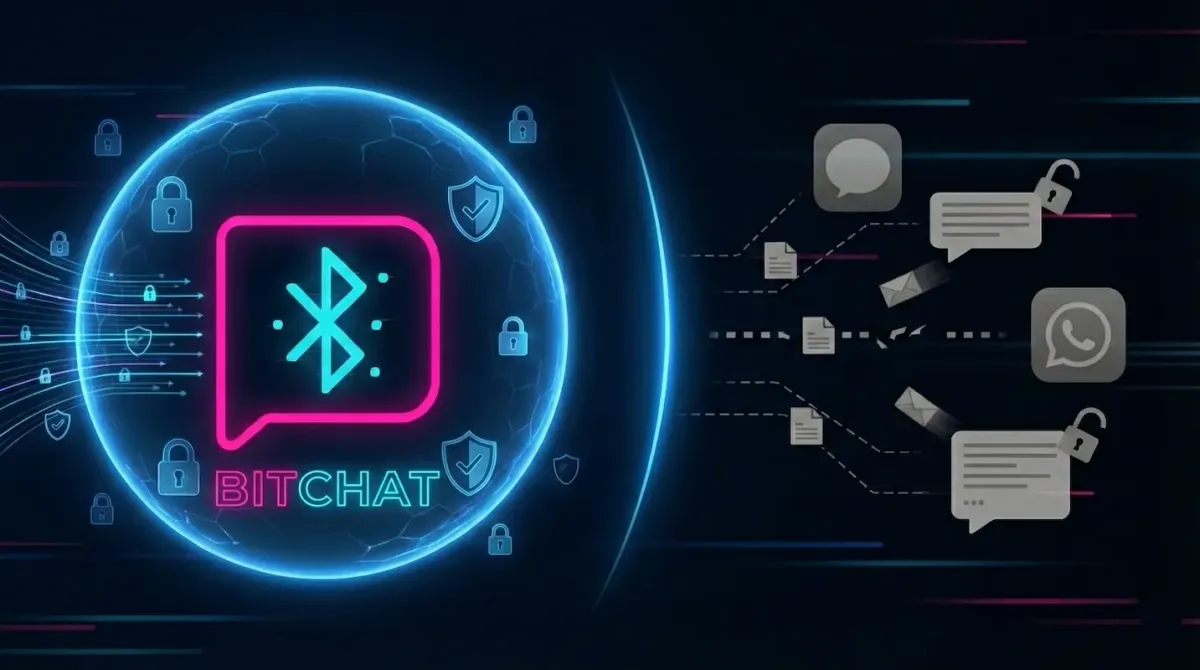
In 2026, most people understand that free messaging apps come with a hidden tradeoff. While platforms like WhatsApp, Telegram, and Signal advertise strong encryption, they still depend on central servers and phone numbers. These two elements create privacy risks that security researchers have warned about for years.
This is where BitChat takes a radically different path.
Released in mid 2025 by Twitter co-founder Jack Dorsey, BitChat is not built to compete on emojis or cloud backups. Instead, it removes the internet itself from the communication chain. By doing so, it delivers a level of privacy and resilience that traditional chat apps cannot offer.
Below is a clear comparison of how BitChat protects user privacy compared to mainstream messaging platforms.
No Central Servers and No Metadata
The biggest privacy weakness of most chat apps is centralization.
Traditional messaging services route every message through company-owned servers. Even when message content is encrypted, these servers still collect metadata. This includes who you talk to, when conversations happen, and how often messages are exchanged. Companies like Meta can be legally forced to share this information.
BitChat works differently. It uses a peer to peer architecture with no central servers. Locally, messages are transmitted through a Bluetooth mesh network that allows phones to relay messages directly to nearby devices. For long-range communication, BitChat relies on the decentralized Nostr protocol.
Because there is no central authority, there is no metadata database to subpoena, monitor, or breach.
Identity Without Phone Numbers or Accounts
Phone numbers are one of the strongest digital identifiers in modern surveillance.
Most chat apps require a SIM-based phone number to create an account. Once linked, that number can be used to map your contacts, location history, and online identity.
BitChat removes this entirely. There are no accounts, usernames, emails, or phone numbers. When you open the app for the first time, it generates a cryptographic key pair. This key becomes your identity.
You exist on the network without revealing who you are.
Works Without the Internet
Internet shutdowns have become increasingly common during protests, conflicts, and political unrest.
Traditional chat apps stop working immediately when Wi-Fi or mobile data is blocked. Governments can disable communication by blocking servers or restricting internet access.
BitChat is designed to function without any internet connection. Using Bluetooth Low Energy, nearby devices automatically discover each other and relay messages across a physical mesh. Messages can hop between phones over distances of up to 300 meters per device.
In real-world terms, this means people can continue communicating inside blackout zones, disaster areas, or censored regions where traditional apps fail.
Built-In Emergency Wipe
BitChat was built for high-risk environments.
Many messaging apps claim messages disappear after deletion, but remnants often remain in backups or device storage. Forensic tools can sometimes recover this data.
BitChat includes a gesture-based emergency wipe feature. By triggering a specific action inside the app, all cryptographic keys and local message databases are instantly destroyed. Since BitChat does not rely on cloud storage, the data is permanently unrecoverable.
Once wiped, the app becomes a blank slate with no historical trace.
Privacy Comparison Table
| Feature | Traditional Chat Apps | Signal | BitChat |
|---|---|---|---|
| Server Architecture | Centralized | Centralized | Decentralized |
| Requires Internet | Yes | Yes | No |
| Requires Phone Number | Yes | Yes | No |
| Metadata Collection | High | Low | None |
| Works During Shutdowns | No | No | Yes |
Conclusion
BitChat is not designed for convenience-first messaging. It is designed for survival, anonymity, and censorship resistance.
While apps like WhatsApp and Signal improve privacy compared to older platforms, they still depend on centralized infrastructure and identity tracking. BitChat removes those dependencies entirely.
For journalists, activists, or anyone who values true privacy, BitChat offers something rare in modern technology: communication without trust in infrastructure.
Source - github.com/permissionlesstech , Wikipidia , nostr.com
Frequently Asked Questions