
 English
 Russian
 Español
 Français
 Deutsch
 हिन्दी
 සිංහල
සිංහල 中文
中文 日本語
日本語
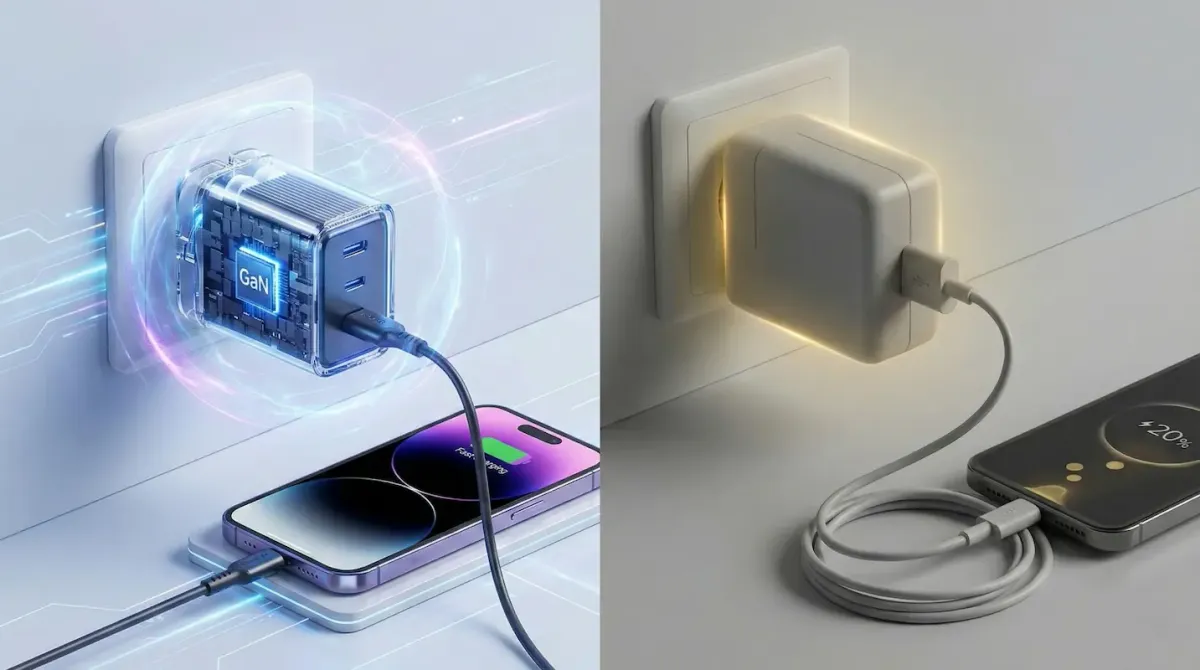
If you have purchased a new laptop or a high-end smartphone recently, you might have noticed something surprising about the power brick. A few years ago, a 65W laptop charger was a heavy object the size of a brick that weighed down your backpack and got uncomfortably hot. Today, you can buy a 65W charger that is the size of a cookie and fits easily in your pocket.
The secret technology behind this incredible shrinking act is called GaN (Gallium Nitride). It is widely considered the biggest upgrade to charging technology in the last 20 years.
In this guide, we will explain exactly what a GaN charger is, the science behind why it is superior to the "normal" chargers you have used all your life, and the few downsides you need to be aware of before you make a purchase.
The Science: What Exactly is GaN?
To understand why GaN is special, we first need to look at what came before it, which is Silicon.
For the last 40 years, almost all electronics, from the computer chips in your PC to the power adapter for your old Nokia, were made using Silicon transistors. Silicon is cheap, abundant, and easy to manufacture. However, Silicon has a physical limit. It is not very efficient at conducting high voltages without generating significant heat. As our devices demanded more power for fast charging, Silicon chargers had to become larger and larger to dissipate that heat safely.
Enter Gallium Nitride (GaN).
GaN is a crystal-like semiconductor material. It is not exactly new technology because it was actually used in the 1990s to create blue LEDs for Blu-ray players. However, scientists recently figured out how to use it inside power adapters.
Think of electricity flowing through a material like a car driving on a road. Silicon is like a bumpy dirt road. The electricity can travel on it, but if you try to push too much power too fast, there is friction that creates heat. GaN is like a super-smooth modern highway. It creates a "wider bandgap" which allows electricity to move at incredibly high speeds with far less resistance. This fundamental difference in chemistry is what changes everything for your phone charger.
Why Is GaN Better Than "Normal" Chargers?
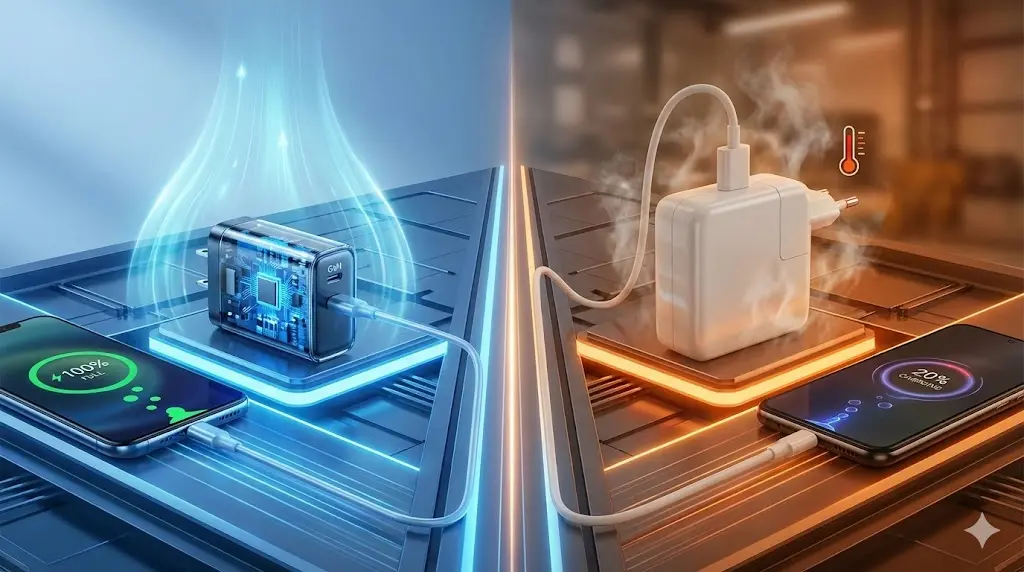
Because Gallium Nitride conducts electricity so much more efficiently than Silicon, it offers three massive advantages that change how we use our devices.
1. Significantly Smaller Size
The most obvious benefit is portability. In a traditional Silicon charger, components generate a lot of waste heat. To prevent the charger from melting or catching fire, manufacturers have to space out the internal components and add bulky metal plates called heatsinks to absorb the heat. This makes the final product large and heavy.
GaN chargers run naturally cooler because they are more efficient. This allows engineers to pack the internal components tightly together without worrying about overheating. As a result, a modern GaN charger is often 50% smaller than a Silicon charger of the same power. This is why you can now find tiny "Nano" chargers that are powerful enough to charge a MacBook Pro but are no bigger than an old iPhone 5W plug.
2. Higher Energy Efficiency
When you plug any charger into a wall outlet, it does not transfer 100% of the electricity to your device. Some of that energy is lost during the conversion process from AC to DC and turns into heat.
Silicon chargers typically have an efficiency rating of around 87%. That means 13% of the electricity you pay for is wasted as heat. GaN chargers typically have an efficiency rating of around 95%. While this might seem like a small difference on paper, it adds up over time. A GaN charger wastes less electricity, which is better for your electric bill and the environment.
3. Faster Switching Frequency
This is the technical secret behind the technology. Inside every charger, there is a transistor that switches on and off thousands of times per second to convert the power. Silicon can only switch so fast before it becomes unstable. GaN can switch 3x to 100x faster than Silicon.
Because the switching happens so much faster, the other massive components inside the charger, specifically the transformer and capacitors, can be made much smaller. This is the main engineering reason why GaN chargers are so compact compared to their ancestors.
Are There Any Downsides? (The Cons)
If GaN is so perfect, you might be wondering why every single charger isn't made of it yet. While the technology is superior, there are a few downsides and risks to consider.
1. Higher Manufacturing Cost
Gallium Nitride is much harder to produce than Silicon. Silicon is essentially refined sand, which is available everywhere. GaN must be synthesized in a complex high-temperature process. As a result, GaN chargers are more expensive to buy. A standard 30W Silicon charger might cost you $10, whereas a high-quality 30W GaN charger from a brand like Anker or Ugreen might cost $20 to $30. You are paying a premium for the smaller size.
2. Heat Issues in "Mini" Models
It sounds contradictory to say GaN runs cooler but also has heat issues. The problem lies in the design. Because GaN allows manufacturers to make chargers incredibly tiny, some brands make them too small.
If a charger is the size of a coin, there is almost no surface area for the heat to escape. Even though GaN generates less heat, that heat still needs to go somewhere. Some ultra-compact, cheaper GaN chargers can become extremely hot to the touch because they lack the plastic surface area needed to dissipate heat into the air.
3. Potential Interference (EMI)
This was a major issue with early GaN chargers a few years ago, though it is mostly solved now. Because GaN switches at such high frequencies, it can create "Electromagnetic Interference" (EMI) or electrical noise. In the past, plugging a cheap GaN charger near a sensitive audio device or a radio could cause a buzzing sound. Modern chargers from reputable brands have shielding to prevent this, but it is still a risk with unbranded, cheap units.
Conclusion: Should You Buy One?
The decision to switch to GaN depends largely on your lifestyle. The technology is undeniably better, but it is not strictly necessary for everyone.
If you are a traveler, a student, or someone who commutes to work, a GaN charger is a fantastic investment. The ability to replace a heavy laptop brick, a phone charger, and a tablet charger with a single, pocket-sized block is a game-changer for your backpack.
However, if your charger simply stays plugged into the wall behind your desk and never moves, you do not need to spend the extra money on GaN. A traditional Silicon charger will charge your device just as fast and safely. It will just be larger. Looking at the trends, Silicon is slowly dying out, and the future of power is definitely Gallium Nitride.
Source - anker.com , navitassemi.com , belkin.com
Frequently Asked Questions