Brain Computer Interfaces: Wiring the Mind to the Machine
Learn what Brain-Computer Interfaces are, how they work, and their real-world applications in medicine, AI, and future technology in 2026.

 English
 Russian
 Español
 Français
 Deutsch
 हिन्दी
 සිංහල
සිංහල 中文
中文 日本語
日本語
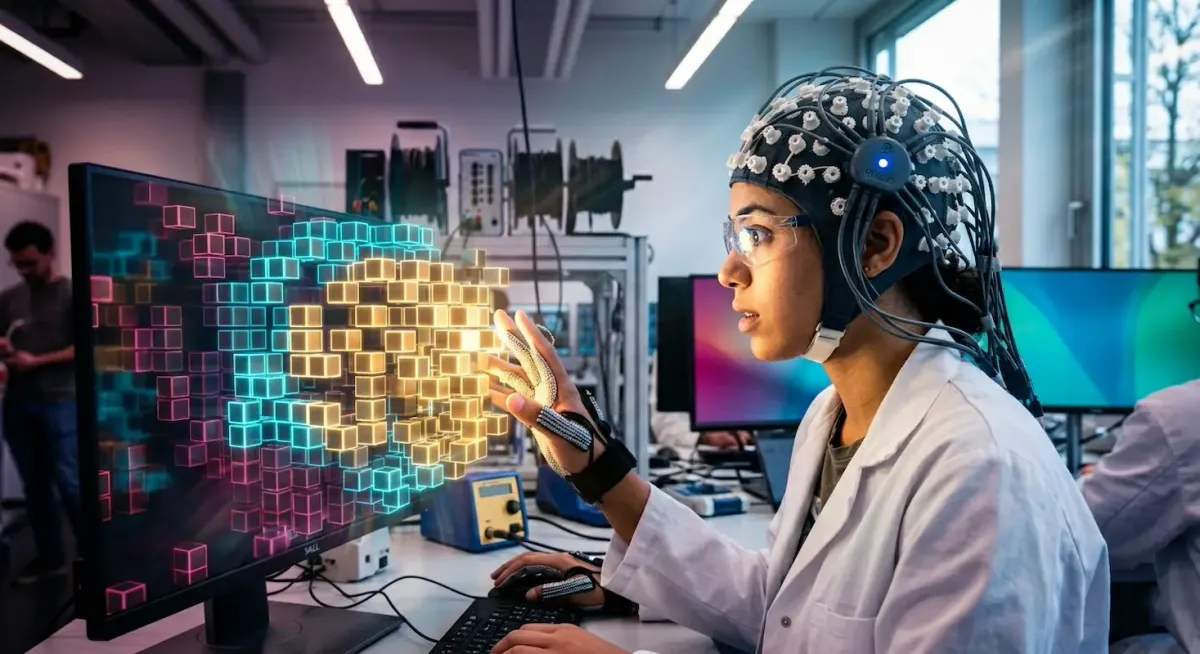
A Brain-Computer Interface (BCI) is a technology that establishes a direct communication pathway between a human brain and an external device such as a computer, robotic limb, or wheelchair by interpreting neural signals. It enables users to control external devices directly with their thoughts, bypassing damaged motor pathways, commonly to restore communication or movement in paralyzed individuals.
Imagine composing an email without touching a keyboard, moving a robotic arm with the flicker of a thought, or restoring speech to someone who lost it years ago not through science fiction, but through the precise translation of electrical impulses firing inside the human brain.This is the promise of Brain Computer Interfaces systems that establish a direct communication pathway between the brain and an external device, bypassing the body's conventional muscular and motor channels. What was once confined to academic curiosity and Hollywood screenplays is now appearing in clinical trials, hospital wards, and consumer research labs across the world.
As of 2026, BCI technology stands at a defining inflection point. Hardware is shrinking. Signal resolution is improving. And the social, ethical, and philosophical questions it raises are growing louder than ever before.
How Does a Brain Talk to a Computer?
At its core, a BCI works by detecting the brain's electrical activity tiny voltage fluctuations generated by neurons firing in coordinated patterns and translating those patterns into commands a machine can interpret. This process involves three fundamental stages: signal acquisition, signal processing, and output execution.
Signal acquisition - can be achieved non invasively through electroencephalography (EEG) headsets placed on the scalp, or invasively through microelectrode arrays surgically implanted into brain tissue. Invasive approaches offer far superior signal resolution but come with surgical risks and long-term biocompatibility concerns.
Signal processing - increasingly powered by machine learning. decodes raw neural data into meaningful intent. Modern algorithms can now distinguish between subtle differences in neural firing to determine whether a user intends to move left, right, speak a word, or select an icon on a screen.
Output execution - translates that decoded intent into action: moving a cursor, sending a message, controlling a robotic limb, or even stimulating another part of the nervous system to close a sensory feedback loop.
Applications of BCIs in Neuro Science and Medicine
Brain Computer Interfaces serve as a sophisticated bridge between the human brain and external technology, primarily functioning by translating neural activity into actionable digital commands. In the medical field, they act as powerful neuroprosthetics that restore independence to individuals with neuromuscular disorders such as ALS or spinal cord injuries by allowing them to control robotic limbs, wheelchairs, and exoskeletons through thought alone. Beyond physical movement, BCIs are a critical communication lifeline for patients with locked-in syndrome, decoding brain signals into text or synthetic speech at increasingly rapid speeds. These systems also play a vital role in neurorehabilitation; by providing real time neurofeedback, they encourage the brain’s natural ability to rewire itself, which significantly improves motor recovery in stroke survivors. Furthermore, BCIs are expanding into cognitive health, where they are used to treat conditions like ADHD and anxiety by training users to regulate their own brain patterns, while also offering hands-free environmental control for smart homes and immersive educational tools.
What BCIs Are Already Doing
Motor Restoration: For patients with spinal cord injuries, stroke, or ALS, BCIs offer a lifeline. Systems like BrainGate allow individuals with no functional limb movement to control computer cursors, type, and operate powered wheelchairs using only their neural intent.
Speech Neuroprosthetics: Perhaps the most emotionally resonant application, speech BCIs decode the neural patterns associated with attempted speech and convert them into synthesized voice output - returning communication to those who have lost it entirely.
Mental Health Intervention: Deep brain stimulation (DBS), a form of therapeutic BCI, is already FDA-approved for treatment-resistant depression and Parkinson's disease. Closed-loop systems that detect and respond to pathological brain states in real time represent the next frontier.
Cognitive Enhancement: Most controversially, emerging research explores whether BCIs could augment healthy human memory, attention, and learning -blurring the boundary between therapy and enhancement.
Challenges and Ethical Considerations
The primary technical challenge lies in the reliability and invasiveness of the hardware. For invasive BCIs, there are significant medical risks, such as infection or tissue scarring, while non-invasive systems (like EEG caps) often struggle with signal clarity. Beyond the physical risks, neuro-privacy is a growing concern; because BCIs collect sensitive neural data, they are vulnerable to hacking, which could lead to the unauthorized surveillance or manipulation of a user's thoughts and behaviors. Ethically, this raises questions about autonomy and agency if a robotic arm controlled by a BCI makes an error, it becomes difficult to determine whether the user or the software is responsible.
Future Directions and Emerging Trends
To address these issues, the next generation of BCIs is moving toward fully implantable, wireless systems. These miniaturized devices aim to eliminate the need for wires protruding through the skin, which reduces infection risks and allows users to move freely.
- Advanced Decoding: Researchers are now integrating Artificial Intelligence and Machine Learning to translate brain signals into text or movement with much higher precision and speed.
- Biocompatibility: New materials, such as flexible polymers and "stentrodes" (electrodes delivered through blood vessels), are being developed to make implants last longer without damaging brain tissue.
- Closed-Loop Systems: Future BCIs will likely be "bidirectional," meaning they won't just record brain signals but will also provide sensory feedback to the user, effectively closing the loop between the mind and the machine.
Conclusion
Brain-Computer Interfaces represent one of the most profound technological leaps in human history not because they make us faster or stronger, but because they make us directly connected. They dissolve the boundary between intention and action, between thought and output, and ultimately between what is human and what is machine.
The science is ready. The engineering is advancing. What the world still needs are the conversations the ethical frameworks, the regulatory structures, and the cultural wisdom to ensure that when we wire the mind to the machine, we do not lose what makes the mind worth protecting.
Sources - sciencedirect.com
Frequently Asked Questions