
 English
 Russian
 Español
 Français
 Deutsch
 हिन्दी
 සිංහල
සිංහල 中文
中文 日本語
日本語
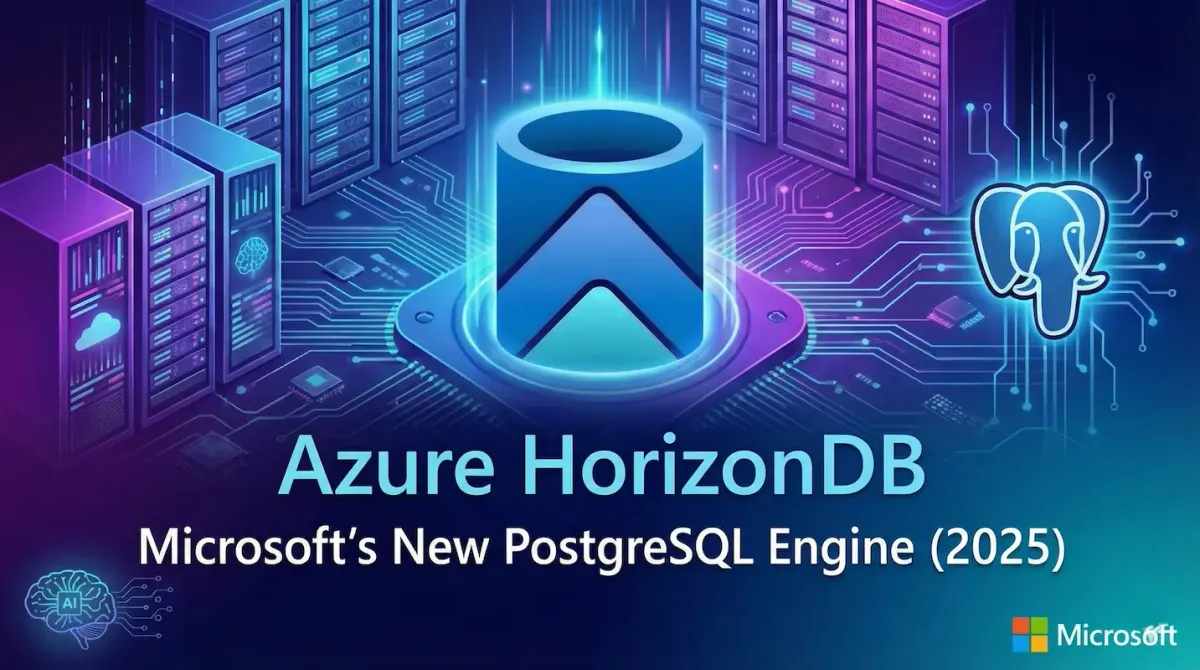
For years, developers using PostgreSQL on Azure had to choose between the standard "Flexible Server" (good for general use) or "Cosmos DB for PostgreSQL" (good for massive global distribution). In late 2025, Microsoft introduced a third, more powerful option: Azure HorizonDB.
Announced at Microsoft Ignite 2025, HorizonDB is a fully managed, cloud-native PostgreSQL database designed specifically for mission-critical performance and AI workloads.
It is not just a simple update; it is a re-engineered storage engine built to handle the extreme demands of modern applications that need to process millions of transactions per second without breaking a sweat.
The Architecture: "Cloud-Native" PostgreSQL
To understand HorizonDB, you have to understand the problem with traditional cloud databases. Usually, a database is just software running on a virtual machine. If that machine gets full, you have to migrate to a bigger one.
HorizonDB uses a disaggregated architecture. This means the "Compute" (the brain processing queries) is separated from the "Storage" (where data lives).
- Elastic Scale: You can add more CPU power instantly without moving data.
- Limitless Storage: It automatically scales storage up to 128 TB without you needing to provision disks manually.
- Performance: It uses a new storage engine optimized for "Write-Ahead Logs" (WAL), allowing for ultra-low latency (under 1 millisecond) even across multiple availability zones.
Top 3 Features for Developers
1. AI-Native Vector Search
HorizonDB was built with the AI boom in mind. It has native support for pgvector and is optimized for high-speed vector indexing. If you are building a RAG (Retrieval-Augmented Generation) app with OpenAI or Gemini, HorizonDB can retrieve context for your LLM faster than standard SQL databases.
2. 3,000+ vCores of Power
Standard databases hit a ceiling. HorizonDB allows you to scale up to a staggering 3,072 vCores. This makes it one of the most powerful single-region database engines on the market, suitable for massive financial systems or real-time gaming backends.
3. "Stateless" Architecture for Resilience
Because the compute nodes don't hold the data, if a node crashes, a new one spins up instantly and connects to the shared storage. This drastically reduces downtime compared to traditional failover methods.
HorizonDB vs. Azure Cosmos DB
The naming can be confusing. Both are databases, but they serve different purposes.
| Feature | Azure HorizonDB | Azure Cosmos DB |
|---|---|---|
| Core Technology | PostgreSQL (Relational) | NoSQL (Document/JSON) |
| Best Use Case | Complex SQL queries, Banking, AI RAG apps | Mobile apps, Gaming profiles, IoT |
| Scaling Focus | Vertical & Storage (Massive single region) | Horizontal (Global distribution) |
| Structure | Strict Tables & Rows | Flexible JSON Documents |
Verdict: Use HorizonDB if you need full SQL compatibility and massive performance in one region. Use Cosmos DB if you need to replicate data to 5 different countries for users worldwide.
Conclusion
Azure HorizonDB is Microsoft's answer to Amazon Aurora. It removes the "heavy lifting" of managing database storage.
If you are building a new AI application or a high-traffic SaaS platform in 2026, HorizonDB is likely the best default choice. It gives you the familiarity of open-source Postgres with the infinite scaling of the cloud.
Source - azure.microsoft.com , techcommunity.microsoft.com , youtube.com , siliconangle.com
Frequently Asked Questions