
 English
 Russian
 Español
 Français
 Deutsch
 हिन्दी
 සිංහල
සිංහල 中文
中文 日本語
日本語
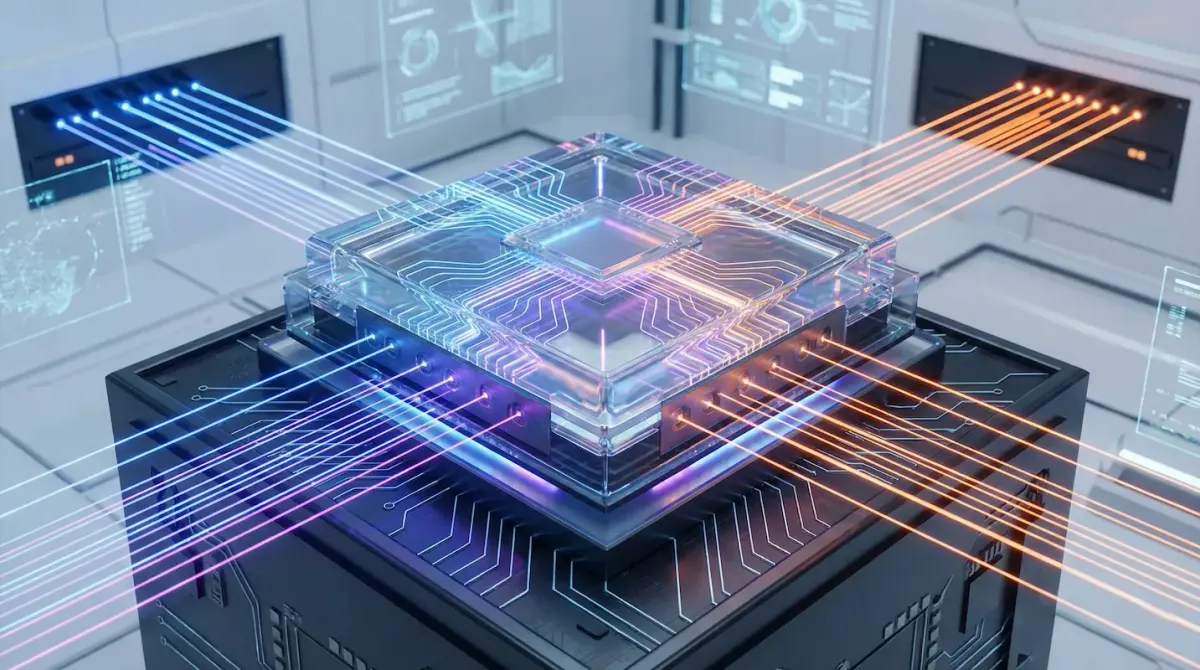
For more than fifty years, the digital world has depended on one core invention: the silicon microchip. These chips process information using electricity, where electrons flow through billions of microscopic transistors that switch on and off to perform calculations. This approach has powered everything from mobile phones to advanced supercomputers. However, this technology is now reaching its physical limits. As engineers try to squeeze more transistors into smaller areas, electrical pathways become thinner, heat levels rise sharply, and electrons struggle to move fast enough to support the growing demands of artificial intelligence and large-scale data processing.
This challenge has opened the door to a new solution: the optical chip. Also known as a Photonic Integrated Circuit (PIC), this technology takes a completely different approach to computing. Instead of relying on electrical signals, optical chips use light to carry and process data. By exploiting the unique properties of photons, engineers can design systems that operate faster, stay cooler, and consume far less energy than traditional silicon-based chips.
What Is an Optical Chip?
An optical chip is a microchip that uses light, rather than electricity, to transmit information. In conventional electronic chips, data travels through copper wires in the form of moving electrons. Optical chips replace these wires with tiny pathways known as waveguides, which guide beams of light across the chip.
A helpful way to visualize this difference is to imagine traffic flow. Electronic chips are like busy city roads filled with cars. As traffic increases, congestion builds up, causing delays and heat. Optical chips are more like fiber-optic networks, where information moves rapidly with almost no resistance. While electronic chips are still essential for complex logic and control tasks, optical chips excel at moving massive volumes of data quickly, making them ideal for modern data centers and AI workloads.
How Do Optical Chips Work?
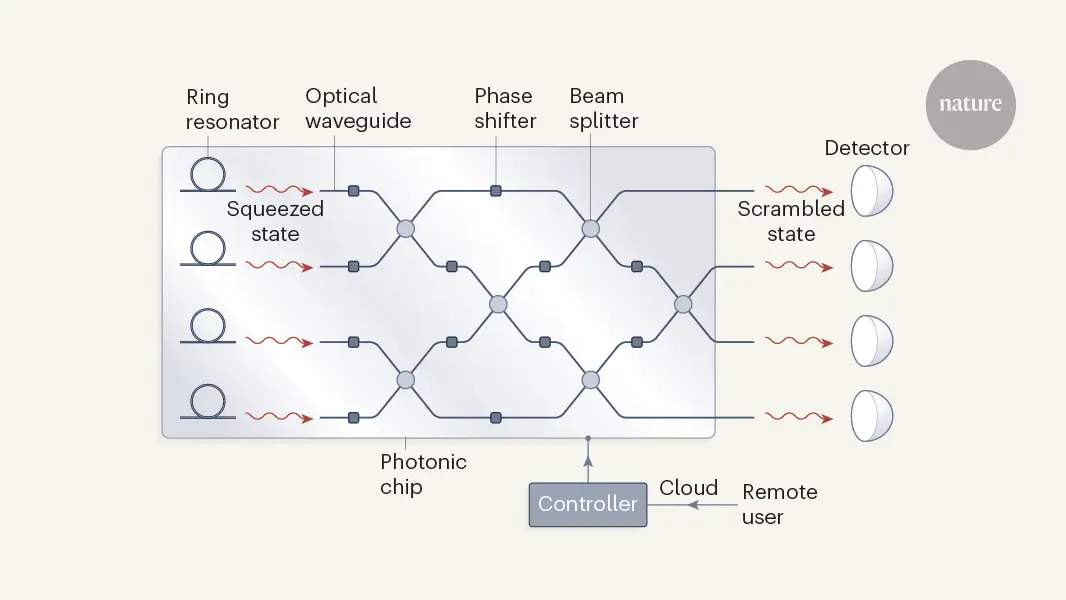
Optical chips rely on several specialized components that replace traditional electronic parts. The process begins with a laser source, which functions like a power supply by generating a stable beam of light. This light acts as the carrier of information.
Next come optical modulators. These components encode data by rapidly changing the light’s intensity or pattern, turning information into digital signals made up of ones and zeros. These changes occur at extremely high speeds, far beyond what most electronic switches can achieve.
The light then travels through waveguides until it reaches a photodetector. This device captures the light and converts it back into an electrical signal that computers can understand and use. Leading technology companies such as Intel and NVIDIA are heavily investing in photonic research to shrink these components and integrate them into real-world servers and data center infrastructure.
The Speed of Light Advantage
One of the greatest strengths of optical computing is its ability to handle enormous bandwidth. Electrical signals weaken as they travel long distances through copper wires, forcing engineers to use repeaters that introduce delay. Light signals, however, can travel much farther with minimal loss.
This advantage is especially important for artificial intelligence training. Large AI models require thousands of GPUs to exchange data continuously. When these systems rely on electrical connections, performance slows as processors wait for information. Optical interconnects allow data to move almost instantly, enabling large clusters of machines to operate as a single, powerful computing unit.
Solving the Heat Problem
Heat generation is a major limitation of electronic computing. As electrons move through metal wires, they collide with atoms and release energy in the form of heat. This is why laptops, chargers, and servers often become hot during heavy use. In large data centers, cooling systems can consume nearly 40 percent of total energy usage.
Photons behave very differently. Because light has no mass or electrical charge, it does not generate heat through resistance. Optical chips can transfer huge amounts of data using far less power than electronic chips. This efficiency reduces operational costs and supports more sustainable, environmentally friendly computing.
The Hybrid Future
Despite their advantages, optical chips are unlikely to fully replace electronic chips in the near future. Light-based systems are excellent for communication and certain mathematical operations, but they are less suitable for complex logic and long-term data storage.
The most practical path forward is hybrid computing. In this approach, traditional silicon processors handle logic and decision-making, while optical chips manage high-speed data transfer. A common design known as co-packaged optics places optical components directly alongside electronic CPUs. This partnership helps extend the progress predicted by Moore’s Law and keeps computing performance improving over time.
Conclusion
Computing is entering a major transition period. Just as transistors replaced vacuum tubes in the mid-20th century, optical technologies are now beginning to complement traditional electronic chips. With the rapid growth of AI, cloud services, and real-time data processing, optical chips are no longer confined to research labs.
By offering faster communication, lower heat output, and improved energy efficiency, optical chips represent a critical step in the future of computing. They are set to play a key role in building the next generation of powerful, scalable, and sustainable digital systems.
Frequently Asked Questions