Reusable Rockets: How SpaceX Changed Space Travel Forever
Discover how SpaceX’s reusable rockets, from Falcon 9 to Starship, slashed launch costs and transformed space exploration from science fiction into a global industry.

 English
 Russian
 Español
 Français
 Deutsch
 हिन्दी
 සිංහල
සිංහල 中文
中文 日本語
日本語
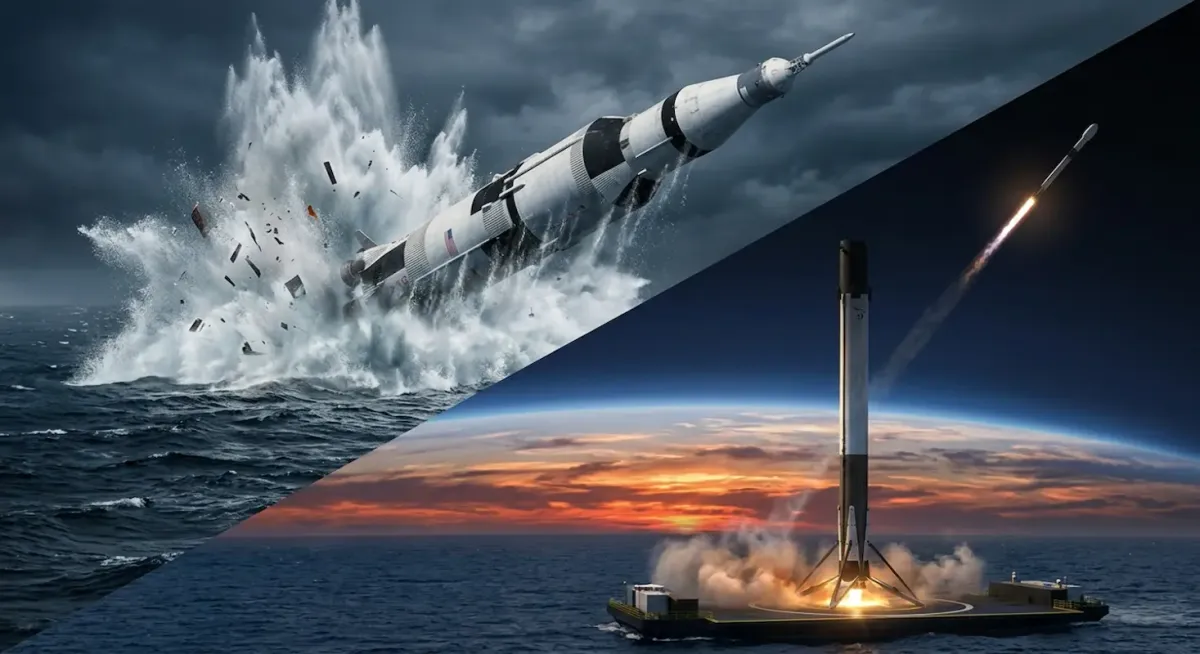
Imagine buying a brand new airplane, flying it once, and then throwing it into the ocean. Sounds absurd, right? Yet for decades, that is exactly how rocket science worked. Every time a rocket launched into space, it was discarded, its massive boosters tumbling into the sea, never to be used again. The result was that space travel remained extraordinarily expensive, achingly slow, and accessible only to a handful of governments with billion-dollar budgets.
For most of human history, the idea of making space travel affordable felt like science fiction. But in the last decade, one company turned that dream into reality and in doing so, rewrote the rules of space exploration forever. This is the story of reusable rockets, and how SpaceX changed everything.
What Are Reusable Rockets?
Reusable rockets are poised to transform the space industry by bringing about profound, game-changing benefits in cost efficiency, sustainability and technological advancement. By significantly reducing the cost of transportation to space, these innovations could make space more accessible than ever before and enable a new era of commercial and scientific exploration.
The Revolution of Reusable Rockets
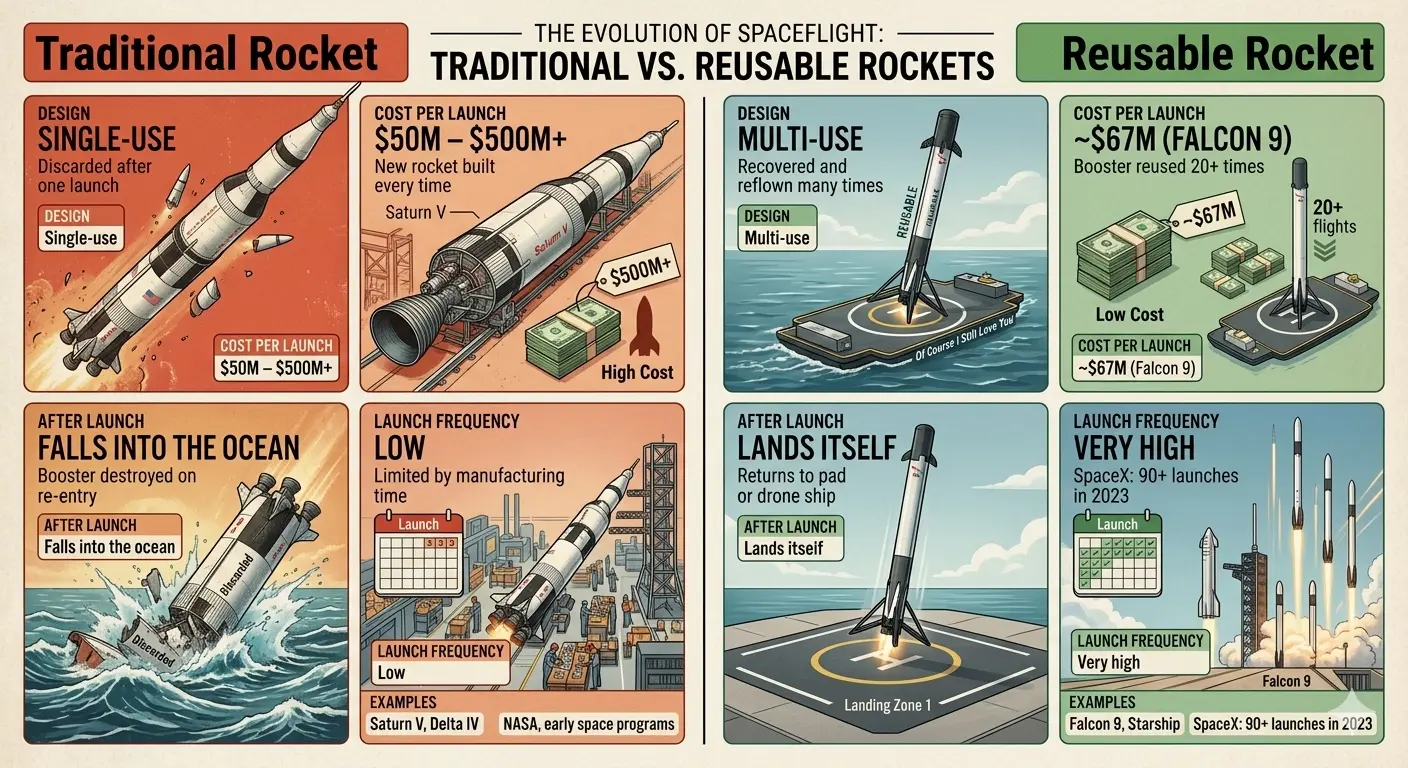
Fully reusable rockets are designed to be launched, recovered, refurbished and relaunched multiple times. Rockets typically consist of stages that separate during the ascent phase. While traditional rockets discard these stages after use, reusable rockets employ advanced technologies such as flight control surfaces, heat shields, thrust vector control and sophisticated flight software to guide and land them safely back on Earth. After recovery, the components undergo inspection and refurbishment to ensure readiness for the next launch. By reusing the same hardware instead of building new rockets for each mission, this approach maximises efficiency, minimises waste and boosts launch frequencies.
The ability to inspect launch hardware and more effectively analyse flight data after each mission enables continuous, iterative improvements to reusable rocket systems. Again, drawing a parallel to other modes of transportation, motor vehicles and air travel were initially accessible only to the wealthy. Over time, advancements in technology, materials, manufacturing techniques and infrastructure have reduced costs, improved safety and made them widely available. Space transport is now following a similar trajectory.While the concept of reusable space systems isn’t new the Space Shuttle was designed with reusability in mind creating a fully and rapidly reusable launch system at affordable pricing was long considered unattainable due to technological limitations. Today, those barriers are being overcome, paving the way for a new era in space exploration.
The Broader Implications of Reusable Rockets
Advancements in rocket technology, particularly fully reusable rockets, bring significant benefits to various industries. High performance materials and innovations in 3D printing and automated processes enhance the aviation, automotive, manufacturing and medical sectors. Rocket propulsion advancements support sustainable energy solutions, while autonomous systems and artificial intelligence improve navigation and control in autonomous vehicles, industrial automation and robotics. These advancements drive efficiency, sustainability and progress across multiple sectors.
Additionally, affordable access to space enables more countries to participate in space missions, fostering collaboration and establishing global standards.The expanding space industry creates economic opportunities by lowering the barriers to entry for businesses, fostering innovation and creating new markets such as space tourism and in-orbit services. This growth benefits global communications, weather forecasting and Earth observation, with potential revolutions in energy and mining industries through space-based solar power and asteroid mining.
SpaceX's Breakthrough: Landing the Impossible
SpaceX was founded in 2002 by Elon Musk with one big goal make space travel cheaper. Most people in the industry thought it was impossible.Instead of accepting the single-use rocket model, SpaceX built a rocket that could fly back to Earth and land on its own. That rocket was the Falcon 9.On December 21, 2015, history was made. After delivering satellites to orbit, a Falcon 9 booster flew back, slowed itself down, and landed smoothly at Cape Canaveral. The world was stunned. SpaceX didn't stop there. They built drone ships - unmanned platforms floating in the ocean - so rockets could land even on missions far from shore.
Today, a single Falcon 9 booster has been reused over 20 times. The launch cost is around $67 million, and getting cargo to orbit now costs just $2,700 per kilogram a massive drop from the shuttle era.
Why It Matters: The Ripple Effect
The impact of reusable rockets goes far beyond saving money. It has fundamentally changed what is possible in space.More launches, more often. Because rockets no longer need to be rebuilt from scratch, SpaceX can launch far more frequently. In 2023 alone, SpaceX conducted over 90 launches - more than any other country or company in history. More launches mean more satellites, more scientific experiments, and more opportunities.
Starlink and global connectivity. Reusability made SpaceX's Starlink project possible - a constellation of thousands of small satellites providing high-speed internet to remote and underserved parts of the world. Without cheap, frequent launches, deploying thousands of satellites would have been financially unthinkable.
Opening space to new players. Lower launch costs have opened the door to private companies, universities, and smaller nations that were previously priced out. Today, startups routinely book rides to orbit for their satellites. A new commercial space industry is flourishing, driven directly by the affordability that reusability unlocked.
Inspiring competition. SpaceX's success has pushed the entire aerospace industry to rethink its approach. Blue Origin, founded by Amazon's Jeff Bezos, is developing its own reusable rockets. Rocket Lab recovers its booster engines mid-air using helicopters. Established giants like Boeing and Lockheed Martin have been forced to innovate or risk being left behind.
Space tourism. Reusability has also made civilian spaceflight a reality. SpaceX has already carried private astronauts to the International Space Station and even on free flying missions around Earth - journeys that would have been impossibly expensive in the single-use era.
What's Next: Starship and the Future
If Falcon 9 was a revolution, Starship may be a civilization-changing leap.Starship is SpaceX's next-generation launch system - and it is fully reusable. Both the giant Super Heavy booster and the Starship spacecraft on top are designed to be recovered and reflown. It is the largest and most powerful rocket ever built, standing nearly 120 meters tall and capable of carrying over 100 metric tons to orbit.
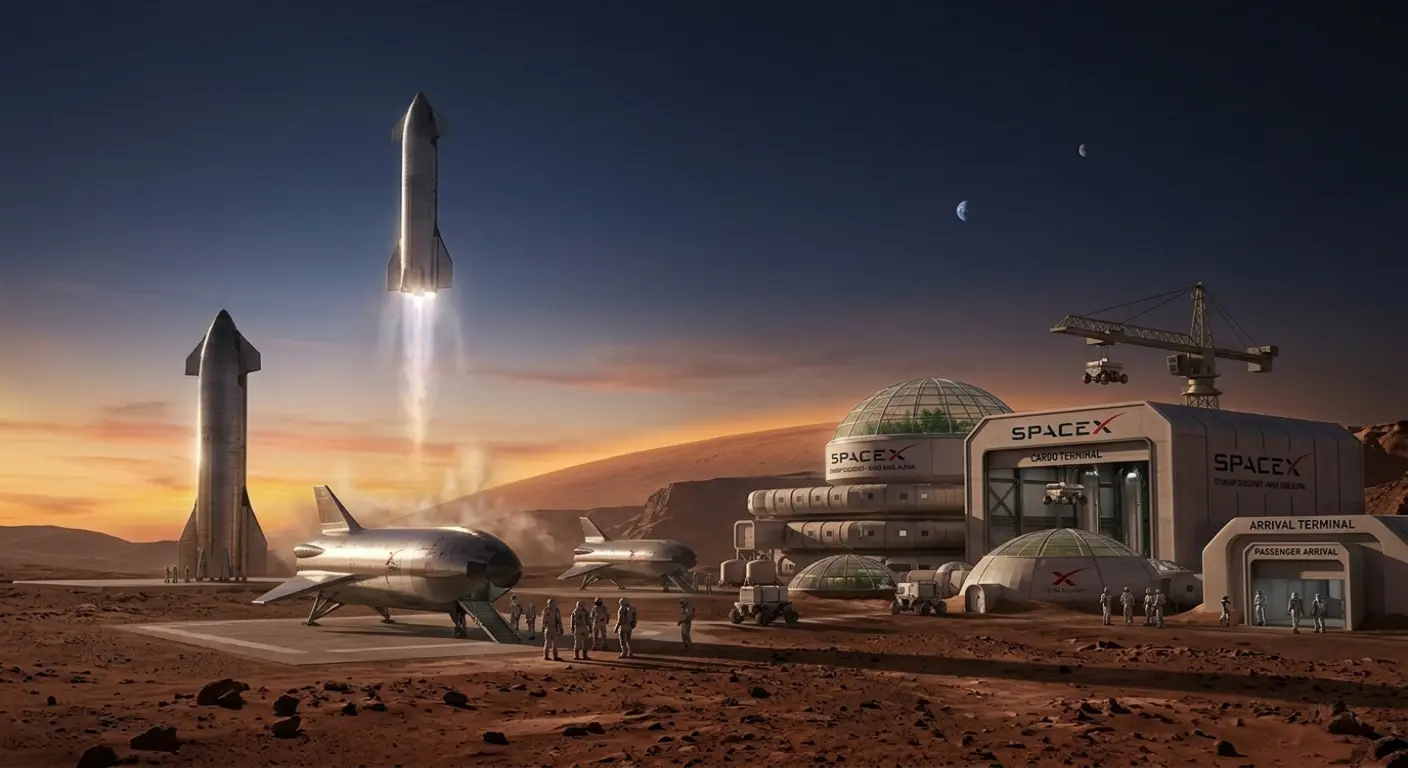
The ambitions for Starship are staggering. SpaceX aims to bring launch costs down to as low as $100 per kilogram to orbit - a hundred-fold reduction from the pre-reusability era. NASA has already selected Starship as the lunar lander for its Artemis program, which aims to return humans to the Moon. Beyond that, Musk envisions Starship carrying 100 passengers at a time to Mars, laying the groundwork for a permanent human settlement on the red planet.
In 2024, SpaceX achieved a stunning milestone - successfully catching the returning Super Heavy booster mid-air using giant mechanical arms on the launch tower, nicknamed "Mechazilla." It was a moment that felt pulled straight from a science fiction novel, yet it was entirely real.
The timeline for Mars missions remains ambitious and uncertain, but the technology is advancing at a pace that few predicted even five years ago.
Conclusion
Reusable rockets are not just a technical achievement - they represent a fundamental shift in humanity's relationship with space. What was once the exclusive domain of superpowers with unlimited budgets is rapidly becoming an accessible frontier for businesses, scientists, and eventually ordinary people.
By solving the seemingly impossible problem of landing a rocket and flying it again, SpaceX dismantled decades of assumptions about what space travel could be. The cost barriers are falling. The launch cadence is accelerating. The ambitions are growing. We stand at the beginning of a new era - one where humans do not just visit space occasionally, but live and work there permanently. And it all began with a rocket, descending from the sky, and landing on its own two feet.
The stars, it turns out, are closer than we thought.
Sources: global-aero.com, spacex.com
Frequently Asked Questions