
NASA’s New Drone Detection System Explained: How It Works and Why It Matters

 English
 Russian
 Español
 Français
 Deutsch
 हिन्दी
 සිංහල
සිංහල 中文
中文 日本語
日本語
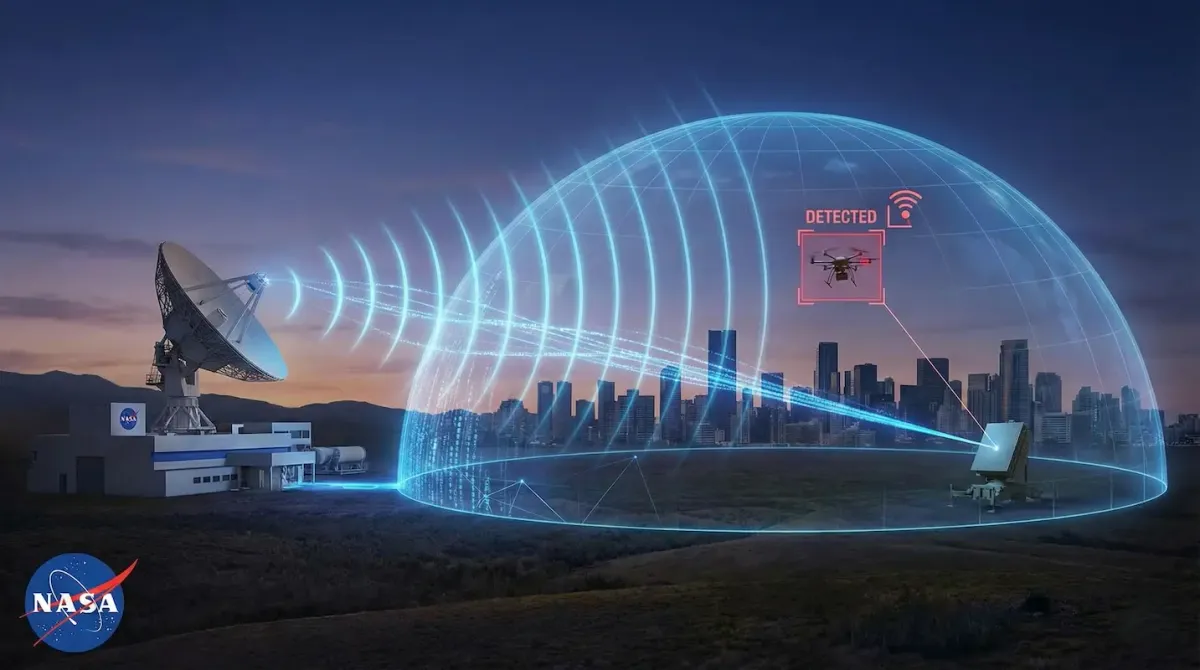
The skies above Florida’s Space Coast are busier than ever. With NASA’s Artemis program pushing humanity back toward the Moon and private companies like SpaceX launching rockets almost weekly, the Kennedy Space Center has evolved into one of the most active spaceports in the world. This increase in activity has also introduced a modern and unexpected challenge: unauthorized consumer drones.
A single hobbyist drone, purchased for a few hundred dollars, can delay or even cancel a billion-dollar rocket launch. To address this risk, NASA has deployed a sophisticated drone detection system designed to secure the airspace around its most critical launch facilities. This system represents a major shift in spaceport safety, ensuring that launches are protected from modern airborne threats.
Unlike traditional air-traffic monitoring tools, this system is purpose-built for small unmanned aircraft. It provides real-time awareness to security teams, allowing them to identify and respond to threats before they compromise a mission.
The Growing Threat of Hobbyist Drones
At first glance, flying a drone near a launchpad might seem harmless. In reality, it is extremely dangerous. Rockets accelerate at incredible speeds and cannot maneuver to avoid small obstacles. A collision with a drone could damage engines, thermal protection systems, or guidance components. In the worst case, it could trigger a catastrophic failure that scatters debris across wide areas.
Before this system was introduced, NASA and the FAA relied heavily on “No Drone Zone” warnings and public awareness campaigns. Despite these efforts, drone incursions still occurred. There have been multiple instances where launch countdowns were paused at the final moments because a drone entered the flight corridor. These last-minute delays, known as scrubs, cost millions of dollars in fuel, labor, and lost launch windows.
The new detection system changes the strategy from passive warnings to active enforcement, allowing NASA to monitor restricted airspace continuously rather than reacting after a violation occurs.
How the Detection Technology Works
The system deployed at the Kennedy Space Center uses a layered “system of systems” approach. Because drones vary widely in size, materials, and flight behavior, no single sensor is sufficient to detect them all.
The first layer is Radio Frequency (RF) detection. Most consumer drones communicate with their controllers using identifiable radio signals. The system continuously scans the spectrum for these signatures. When detected, it can often identify both the drone’s position and the location of the pilot on the ground.
The second layer relies on specialized radar. Some drones operate autonomously or use encrypted links that RF scanners cannot detect. To address this, NASA employs radar systems tuned specifically for small, slow-moving objects. Unlike conventional airport radar designed for aircraft, these sensors can detect objects as small as a dinner plate.
The final layer involves visual confirmation. Once radar or RF sensors flag a target, high-powered electro-optical and thermal cameras automatically focus on the object. This allows operators to confirm whether the target is a drone or something harmless like a bird, significantly reducing false alarms.
Active Monitoring and Rapid Response
Detection alone is not enough. Once a drone is identified, the system’s software immediately analyzes its trajectory and altitude. If the drone crosses a predefined geofence around a launchpad, alerts are triggered in real time.
Sensor data is sent to a centralized command center where artificial intelligence helps fuse inputs from multiple sources. This allows security teams to act quickly and confidently. In most cases, law enforcement is dispatched to the pilot’s location and instructs them to land the drone.
For launch directors, this system provides critical decision-making data. Instead of relying on visual reports or delayed confirmations, they receive precise, real-time information that helps determine whether a countdown can safely continue.
Why This Matters for the Future of Spaceflight
This technology is not just about preventing launch delays. It is about protecting human life and national assets. As NASA prepares crewed missions under the Artemis program, the margin for error becomes even smaller. Any external risk during ascent could have fatal consequences for astronauts.
The system also protects sensitive technology. Modern drones can carry advanced cameras and sensors capable of gathering intelligence on proprietary or classified hardware. Securing the airspace helps protect the intellectual property of commercial partners and the strategic interests of the United States.
According to Aviation Week, demand for counter-UAS capabilities has accelerated across the aerospace industry. What NASA learns at Kennedy Space Center will likely influence security standards at other spaceports and critical infrastructure sites worldwide.
The Legal Landscape of Counter-UAS Operations
Although NASA can detect and track drones, physically disabling them is legally complex. Federal regulations generally prohibit GPS jamming or destroying drones due to potential risks to civilian airspace and people on the ground.
However, certain federal agencies, including NASA, have limited authority to take action against drones that pose credible threats. The detection system provides the verified data required to justify those actions when necessary. In practice, most incidents are resolved simply by identifying and stopping the operator.
A Safer Spaceport for Everyone
As launch frequency increases, drone detection technology will become as essential to spaceports as radar is to airports. It allows advanced spaceflight operations to coexist with the widespread use of consumer drones.
As reported by Rolling Out, this system represents a major win for public safety and operational reliability. It ensures that rocket launches remain moments of inspiration rather than sources of risk.
NASA has once again demonstrated that reaching the stars begins with mastering safety on Earth. By securing the skies above Kennedy Space Center, it keeps the gateway to space open for exploration and closed to unnecessary danger.
Frequently Asked Questions