Deep Research Agent Upgraded: Google Unlocks Gemini 3 Pro Power
 English
 Russian
 Español
 Français
 Deutsch
 हिन्दी
 සිංහල
සිංහල 中文
中文 日本語
日本語
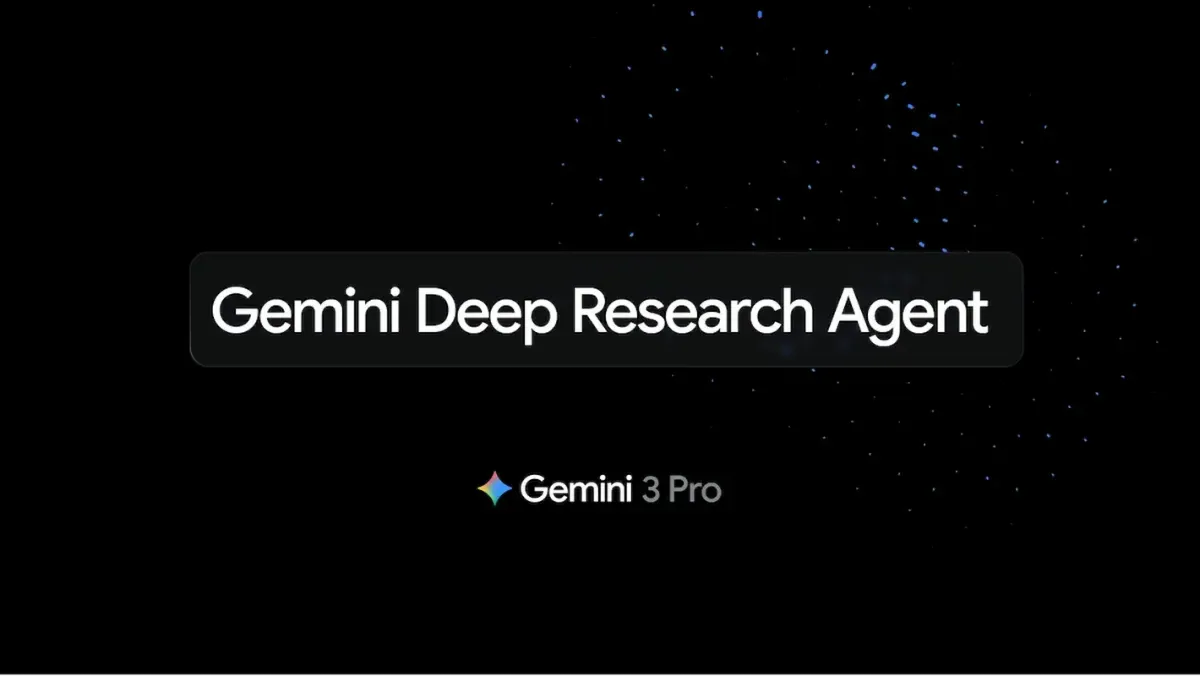
The way we gather information online is changing forever. In a digital world where data is endless but time is scarce, professionals and researchers often spend hours sifting through hundreds of tabs to find a single answer. The challenge is no longer just finding information. The real challenge is synthesizing it into something useful without spending days on manual verification. Google has just taken a massive leap forward in solving this problem with the release of its upgraded Deep Research Agent.
This new tool is not just a chatbot that summarizes text. It is a fully autonomous research assistant powered by the newly released Gemini 3 Pro model. It has been designed to think, plan, and execute complex research tasks that would typically take a human expert hours to complete. By combining the reasoning capabilities of Gemini 3 Pro with an iterative research workflow, Google is redefining what artificial intelligence can do for knowledge workers, developers, and enterprises.
What is the Upgraded Deep Research Agent?
The Deep Research Agent is an advanced AI system built to handle open-ended research questions. Unlike standard large language models that generate a response based on a single prompt, this agent acts more like a human researcher. When you ask it a complex question, it does not just guess the answer. Instead, it creates a detailed plan.
It breaks down your request into multiple steps and actively navigates the web to find the best sources. It reads through documents, cross-references facts, and synthesizes the findings into a comprehensive report. This capability was previously introduced in a limited capacity, but the upgrade to the Gemini 3 Pro engine has unlocked a new level of depth and reliability. The agent can now browse hundreds of websites, analyze internal documents like PDFs or CSVs, and combine that internal knowledge with live web data to produce a single, unified output.
Powered by the Gemini 3 Pro Engine
The core of this upgrade is the integration of Gemini 3 Pro, which Google released in November 2025. This model is widely regarded as Google’s most intelligent and factually accurate AI to date. Gemini 3 Pro brings a massive improvement in reasoning capabilities, allowing the Deep Research Agent to understand nuance and context better than ever before.
One of the standout features of the Gemini 3 Pro engine is its thinking capability. The model uses reinforcement learning to pause and reason before generating an answer. This "thinking time" allows the agent to evaluate its own search results. If it finds conflicting information, it does not just pick a side randomly. It recognizes the discrepancy and performs additional searches to resolve the conflict. This reduces the hallucination rate significantly compared to older models like Gemini 1.5 Pro.
How the Iterative Research Process Works
The magic of the Deep Research Agent lies in its workflow. It follows a multi-step process that mirrors human cognition:
- Planning: First, it analyzes the user's prompt to understand the core objective and formulates a research plan with specific sub-questions.
- Execution: The agent starts executing searches. It visits websites, reads the content, and extracts relevant data.
- Gap Analysis: It reviews what it has found and identifies gaps. If the initial search yields incomplete data, the agent creates new queries to fill those holes.
- Synthesis: Finally, it compiles everything into a structured report with citations, allowing you to verify every claim.
This cycle of planning, searching, reading, and refining continues until the agent has a complete picture of the topic.
Benchmark-Breaking Performance
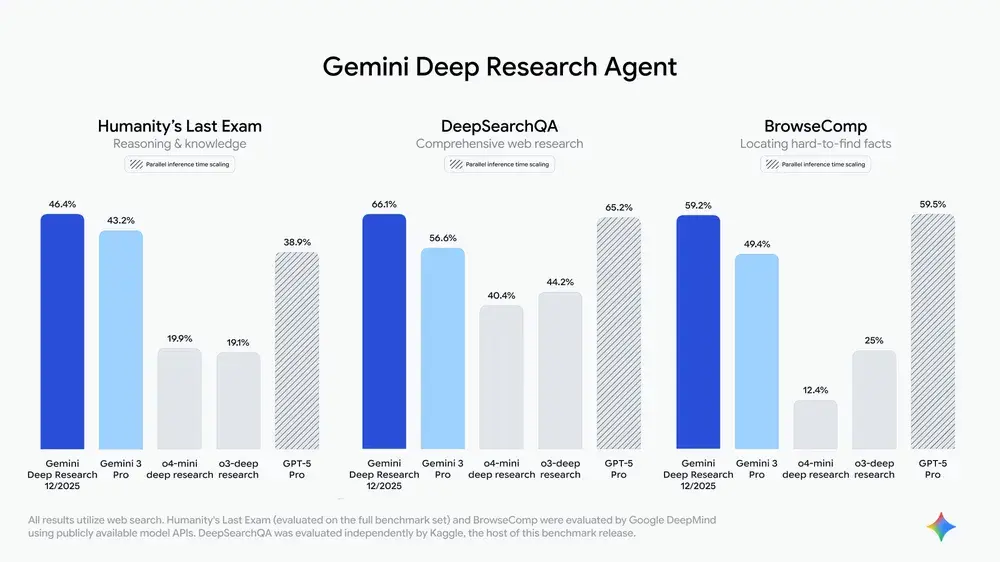
Google has backed up these claims with impressive benchmark scores. The Deep Research Agent has set new records on Humanity’s Last Exam (HLE), a notoriously difficult test designed to stump AI models. The agent achieved a score of 46.4 percent, significantly outperforming the standalone Gemini 3 Pro model which scored 43.2 percent.
Furthermore, on DeepSearchQA, a new benchmark specifically created to evaluate multi-step research tasks, the agent scored an incredible 66.1 percent. These numbers matter because they quantify the agent's ability to handle causal chains. These are tasks where understanding step A is required to figure out step B. In the real world, this translates to better market analysis, more accurate legal research, and reliable technical documentation.
Why This Matters for Professionals
For developers and enterprises, this release opens up new possibilities. The Deep Research Agent is available via the new Interactions API, meaning developers can now build this autonomous research power directly into their own applications.
The ability to upload internal files is another game changer. A business analyst can upload a quarterly sales report (PDF) and ask the agent to compare these sales figures with their top three competitors' performance in Q3 2025. The agent will read the private PDF, search the public web for competitor data, and synthesize a comparison table. This fusion of private and public data automates workflows that previously required manual data entry and analysis.
Transparency and Trust
A major criticism of AI tools has always been the opaque nature of their answers. Users often ask "where did this information come from?" The Deep Research Agent addresses this by providing granular sourcing. Every claim in the final report is linked to its origin.
This transparency builds trust. You can see exactly which website or document the agent used to derive a specific conclusion. If the agent used a competitor's blog post to find a statistic, that link is provided. This feature is critical for users in regulated industries like finance, law, and healthcare, where accuracy and attribution are non-negotiable.
Availability and Access
The upgraded Deep Research Agent is currently available to developers through the Gemini API and Google AI Studio. It is optimized for long-running tasks, meaning it runs asynchronously in the background while you continue working. Google has also announced that these capabilities will soon roll out to consumer apps, including the main Gemini app and Gemini Advanced.
This launch signals a shift from simple chatbots to true agents. We are moving away from simple Q&A interactions toward systems that can perform labor-intensive work on our behalf. With Gemini 3 Pro under the hood, the Deep Research Agent is not just a search tool. It is a tireless research partner ready to tackle the world's most complex questions.
Source - blog.google , deepmind.google , techloy.com
Frequently Asked Questions