 English
 Russian
 Español
 Français
 Deutsch
 हिन्दी
 සිංහල
සිංහල 中文
中文 日本語
日本語

Apple only recently introduced the AirPods Pro 3 in September 2025, adding features like heart rate monitoring, stronger Active Noise Cancellation, and longer battery life. For most buyers, that felt like a complete refresh that would last for years.
But new reports suggest Apple is not done yet.
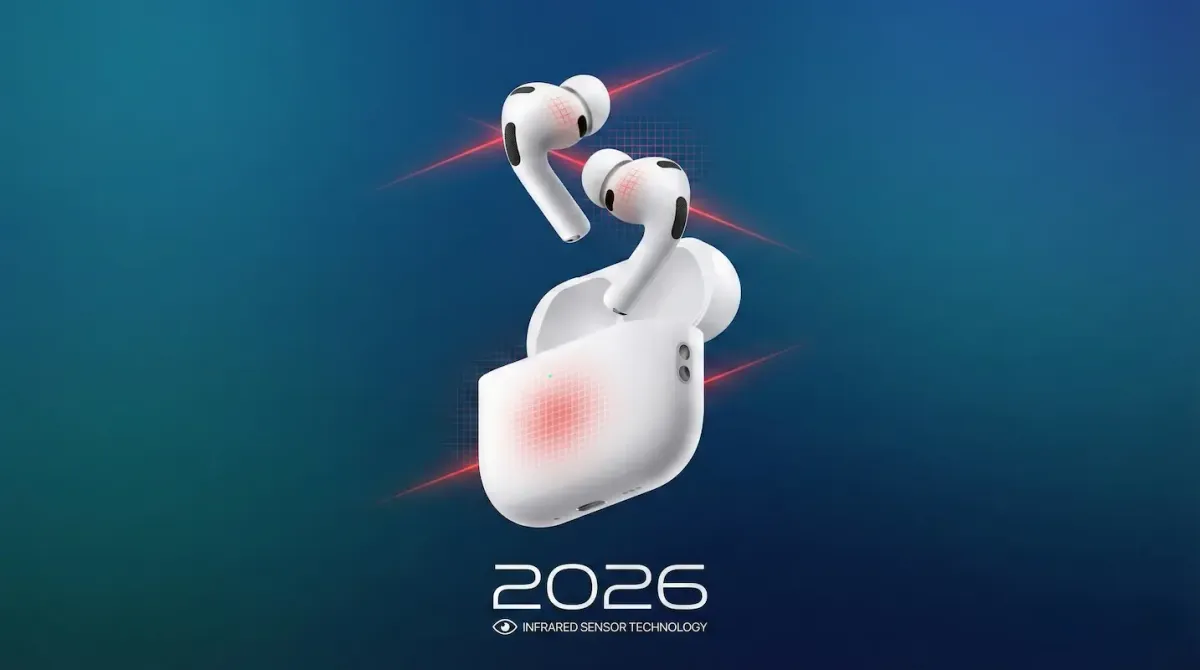
According to respected analysts such as Ming-Chi Kuo and Bloomberg’s Mark Gurman, Apple is preparing a second, more advanced AirPods Pro 3 variant for 2026. The standout feature reportedly being tested is something unexpected: built-in infrared sensors.
This is not about taking photos. It is about spatial awareness and AI integration.
Here is everything we currently know.
The Headline Feature: Infrared Depth Sensors
Reports indicate Apple may integrate infrared depth sensors, similar to the technology used in Face ID on iPhones.
These are not traditional cameras. Instead, they are small IR modules capable of:
- Detecting movement
- Measuring depth
- Mapping nearby surroundings
- Tracking hand gestures
Because infrared sensors work by projecting and reading invisible light patterns, they are better suited for environmental sensing rather than photography.
The goal appears to be turning AirPods into intelligent spatial devices.
What Would IR Sensors Actually Do?
At first glance, cameras in earbuds sound unnecessary. However, industry insiders point to three practical use cases.
1. Gesture-Based Controls
Currently, AirPods Pro users squeeze the stems to control playback. With infrared sensing, Apple could introduce gesture-based controls.
Examples could include:
- Swiping your hand in the air to skip tracks
- Rotating your fingers to adjust volume
- Making simple gestures to answer calls
This would enable fully hands-free control without touching the earbuds.
2. Environmental Awareness and Apple Intelligence
Apple has been heavily investing in on-device AI, often referred to internally as “Apple Intelligence.”
With spatial sensing, AirPods could:
- Automatically adjust noise cancellation based on your surroundings
- Detect if you are walking into traffic and enhance ambient sound
- Provide contextual audio alerts based on location
By combining infrared sensing with AI processing, earbuds could respond intelligently to the physical world around you.
3. Vision Pro Integration
One of the strongest rumors connects these sensors to deeper integration with Apple Vision Pro.
Infrared mapping could:
- Improve head tracking accuracy
- Enhance spatial audio realism
- Reduce latency between movement and sound positioning
This would make AirPods Pro a stronger companion device for mixed reality experiences.
A Two-Tier Strategy for AirPods Pro
Apple may not replace the current AirPods Pro 3. Instead, it could expand the lineup.
Based on analyst predictions:
- Standard AirPods Pro 3 would remain around $249
- A premium tier would launch above it
- The new version would bridge the gap between Pro models and the $549 AirPods Max
Apple previously used a similar strategy with its regular AirPods lineup, offering multiple tiers simultaneously.
This approach allows Apple to test advanced hardware without forcing every user to pay for it.
The Possible H3 Chip Upgrade
Processing live infrared data requires additional computational power.
To manage this without draining battery life, the rumored high-end model could debut a next-generation H3 chip. The current AirPods Pro 3 use the H2 chip.
An upgraded chip would likely provide:
- Faster AI processing
- Improved latency for spatial audio
- Better battery efficiency despite added sensors
On-device processing is critical for privacy and performance, so Apple would need a powerful chip to make this system practical.
Privacy Considerations
Whenever sensors or cameras are mentioned, privacy concerns follow.
However, infrared depth sensors differ from standard cameras. They do not capture identifiable images. Instead, they interpret movement and depth data.
If Apple keeps all processing on-device and avoids cloud storage, the system could maintain the company’s privacy-first positioning.
Expected Release Timeline
Industry analysts currently suggest:
- Announcement likely in the second half of 2026
- Limited rollout initially
- Premium pricing above the standard Pro 3 model
Apple has not officially confirmed this product, so timelines may change.
Conclusion
If the rumors are accurate, Apple is transforming AirPods from simple audio accessories into intelligent spatial wearables.
Infrared sensors may sound unusual in earbuds, but they align with Apple’s long-term strategy of ambient computing and wearable AI.
Instead of replacing your screen, future devices may understand your environment and respond automatically. AirPods Pro with spatial sensing could be one of the first mainstream steps in that direction.
Source - macrumors.com , 9to5mac.com , notebookcheck.net
Frequently Asked Questions